On September 4, 2026, Beijing time, OpenAI introduced GPT-6 Astra, its latest flagship AI model.
You may be wondering:
What does a new AI model have to do with cable ties?
At first, the connection may not seem obvious. Artificial intelligence and nylon cable ties belong to completely different industries.
But for a cable tie manufacturer like us, AI is beginning to change an important part of product development: how quickly we can turn a customer’s idea into something that can be seen, discussed, refined, and eventually manufactured.
For us, the connection is practical: AI-assisted 3D modeling can help turn ideas for custom cable ties into visual concepts much earlier in the development process.
And that is exactly what we have recently been experimenting with.
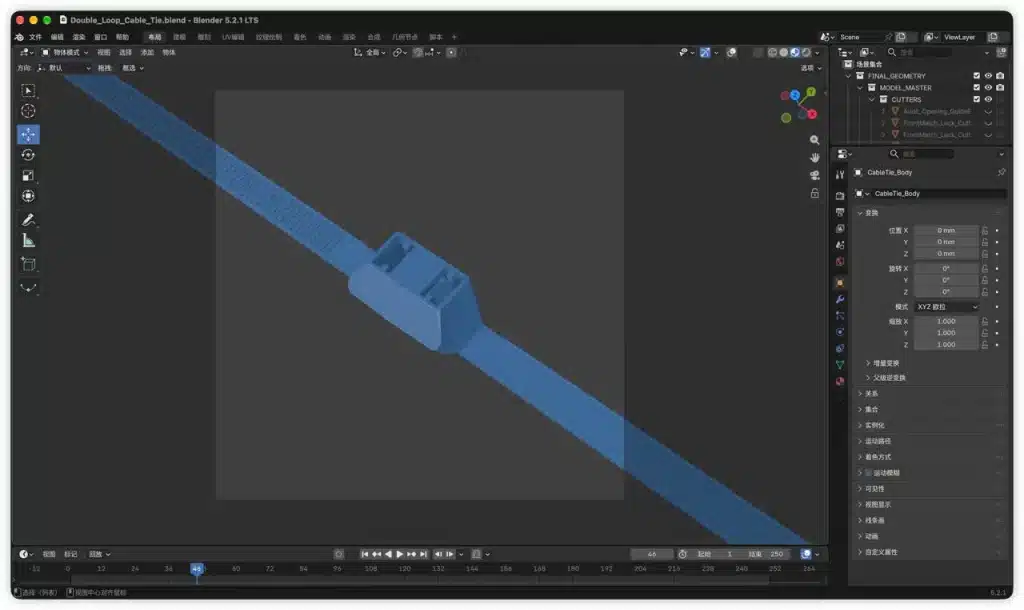
Blender.
How Custom Cable Ties Were Traditionally Developed
A standard nylon cable tie may look simple.
There is a locking head, a flexible strap, and a series of teeth.
But anyone involved in cable tie manufacturing knows that a reliable cable tie depends on many small engineering details.
When developing custom cable ties, factors such as strap length, width, thickness, tooth geometry, locking mechanism, head dimensions, internal channel design, material properties, tolerances, and tensile strength can all affect how the final product performs.
Traditionally, when a customer approached us with an idea for a new cable tie, the development process often started with drawings, photographs, samples, or basic specifications.
Our engineers would then create a CAD or 3D model.
The model would be reviewed.
Changes would be made.
The customer would review it again.
Once the design was close to final, we could move on to prototyping, engineering validation, tooling, mold development, and eventually mass production.
For special cable tie designs, this process could involve several rounds of communication.
And in many cases, one of the biggest challenges was not manufacturing the product itself.
It was making sure that we and the customer were imagining exactly the same product.
What Changes With AI-Assisted 3D Modeling?
This is where tools such as GPT-6 Astra, Codex, and Blender become interesting.
Recently, we tested an AI-assisted workflow to explore how custom cable ties could be visualized and refined more efficiently, using a double-loop, handcuff-style cable tie as our reference product.
Instead of beginning with a complete engineering drawing, we started with reference images.
We then used GPT-6 Astra to assist Codex in generating and refining the modeling logic inside Blender, an open-source professional 3D modeling application.
The AI helped us interpret the visible proportions, geometry, and structural features of the reference product, while Blender provided the environment in which the actual 3D geometry was created and adjusted.
The first model was not perfect.
Nor did we expect it to be.
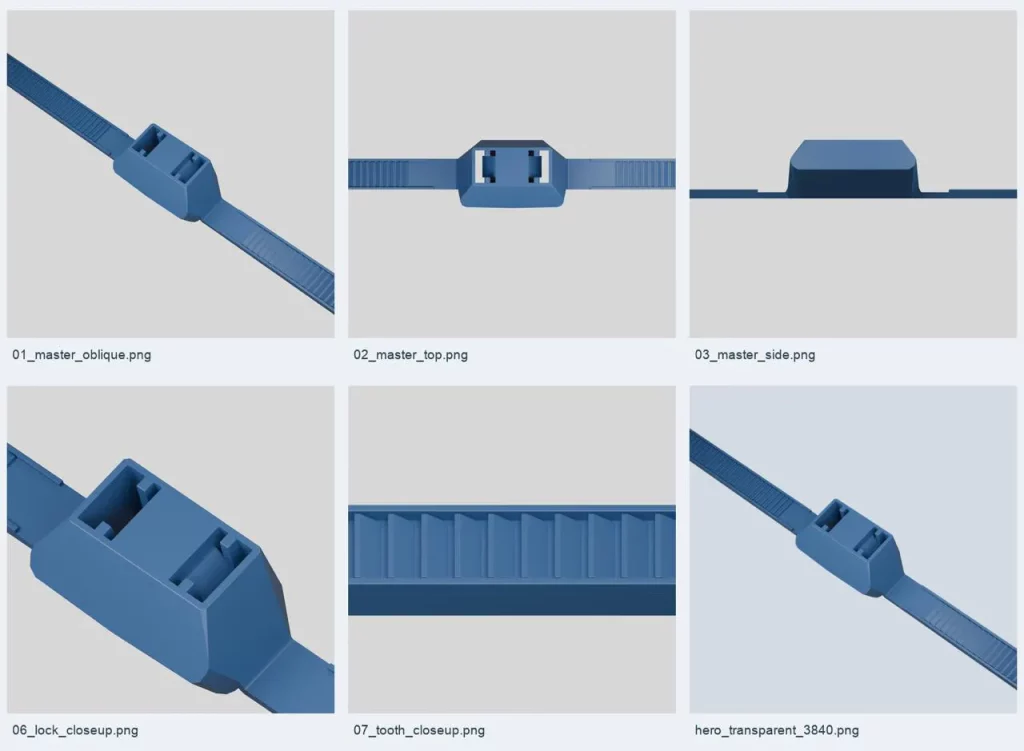
We continued comparing the 3D model with the reference images, adjusting dimensions, correcting proportions, refining the locking-head geometry, and improving the strap and tooth structure.
Gradually, the model became closer to the physical product.
In the final render, even small details such as the strap teeth, locking heads, and overall geometry could be clearly seen.
This was not a one-prompt experiment. T. WANG, who conducted the original test, went through repeated rounds of visual comparison, code generation, geometry adjustment, rendering, and verification. Over the course of the experiment, approximately US$200 in AI token and API usage costs was consumed while refining the model.
The cost itself was not the objective. The real value of the experiment was learning where AI could genuinely accelerate the modeling process, where it still made mistakes, and where human judgment remained essential.
That alone creates an important advantage.
Instead of discussing a new cable tie only through words or two-dimensional drawings, both the manufacturer and the customer can look at the same three-dimensional object.
The customer can see it from different angles.
And if something looks wrong, it can be identified much earlier.
What If a Customer Only Has a Sketch?
This may be where AI-assisted product development becomes even more valuable.
Not every customer looking for a custom cable tie manufacturer arrives with a complete engineering drawing.
In fact, many custom cable ties begin with nothing more than a practical problem that an existing standard cable tie cannot solve.
Sometimes they have a hand-drawn sketch.
Sometimes they have a photograph of an existing product.
Sometimes they have a physical sample.
And sometimes they simply have an idea.
A customer might tell us:
“Can you add another mounting hole here?”
Or:
“We need this cable tie to secure two separate bundles.”
Or:
“Can the locking head be made thinner?”
In a traditional development process, these ideas first need to be translated into something engineers can model and evaluate.
With AI-assisted 3D modeling, we now have another way to accelerate that first step.
A rough idea can be turned into an initial 3D concept more quickly.
The customer can then look at the model and say:
“This section should be longer.”
“The hole needs to move.”
“The head should be wider.”
“That is not quite what I had in mind.”
And suddenly, an idea that previously existed only in someone’s mind becomes something both sides can actually see and discuss.
For custom manufacturing, that is a meaningful improvement.
Can an AI-Generated 3D Model Go Straight Into Tooling?
No.
And this distinction is extremely important.
AI can help accelerate concept development, visualization, communication, and early-stage modeling.
But a model that looks correct is not necessarily a model that is ready for manufacturing.
Cable ties are functional products.
Their performance depends on much more than appearance.
The interaction between the locking pawl and the strap teeth matters.
Tooth pitch matters.
Strap thickness matters.
Material selection matters.
Dimensional tolerances matter.
Injection molding shrinkage matters.
And ultimately, tensile strength and locking performance matter.
Before custom cable ties move into tooling and mass production, each design still needs proper engineering review.
Dimensions must be verified.
Critical structures must be optimized.
Manufacturability must be evaluated.
Prototypes may need to be produced and tested.
The mold itself must also be engineered around the material, structure, production process, and expected service life.
So we do not see AI as a replacement for product engineers, mold engineers, or manufacturing experience.
Quite the opposite.
AI is another tool in the engineer’s toolbox.
It helps us visualize an idea faster.
But engineering knowledge determines whether that idea can actually become a reliable product.
AI Shortens the Distance Between an Idea and Validation
For us, this is the real value of AI in custom cable tie development.
The goal is not to eliminate every traditional development step.
The goal is to shorten the distance between an idea and a design that can be evaluated.
A more efficient workflow may look like this:
Customer idea → Sketch, photo, or reference sample → AI-assisted 3D concept → Customer review → Design revisions → Engineering validation → Prototype → Tooling → Production
The earlier both sides can see and understand the proposed product, the earlier potential problems can be discovered.
And problems discovered during the concept stage are usually much easier and less expensive to correct than problems discovered after tooling has already begun.
That is particularly valuable in custom manufacturing.
From Traditional Cable Tie Manufacturing to Digital Product Development
Cable tie manufacturing remains a very physical business.
Nylon materials still need to be properly prepared.
Cable ties still need to be injection molded.
Molds still determine the final geometry of the product.
Production parameters still need to be controlled.
And finished cable ties still need to pass quality inspection and performance testing.
AI does not change these basic manufacturing realities.
What it can change is how efficiently we solve problems before production begins.
Tasks that once required repeated manual modeling can increasingly be assisted by AI.
Ideas that customers once found difficult to explain can be visualized earlier.
Design alternatives can be explored faster.
Communication between customers and engineers can become clearer.
For us, innovation is not about using the newest technology simply because it is new.
The more important questions are:
Can this technology help us understand our customers better?
Can it reduce unnecessary communication and revision cycles?
Can it help us identify design problems earlier?
Can it help a new cable tie move from an idea to a manufacturable product more efficiently?
If the answer is yes, then it is worth exploring.
That is why tools such as GPT-6 Astra, Codex, and Blender are relevant to a company that manufactures cable ties.
A New Starting Point for Custom Cable Tie Development
AI-assisted design is still evolving rapidly.
We are continuing to test where it works well, where it does not, and where traditional engineering experience remains essential.
We will not skip the engineering validation required to manufacture a reliable cable tie simply because a 3D model looks convincing on a screen.
But our recent experiments have shown us something important.
In the future, when a customer approaches us with a sketch, a reference image, a sample, or even just an idea, we may be able to begin the conversation in a much more visual way:
“Let’s turn it into a 3D model first and take a look.”
From there, the idea can be reviewed, discussed, refined, tested, and eventually transformed into a real product.
For us, the story of AI and cable tie manufacturing is not about artificial intelligence replacing manufacturing.
It is about using better tools to connect ideas, engineering, and production more efficiently.
Technology will continue to change.
Software will continue to improve.
AI models will become more capable.
But our goal remains the same:
Focused on Every Cable Tie We Make.
This article is based on an original AI-assisted 3D modeling experiment conducted and documented by T. WANG for Cableties.cc.
Have an Idea for a Custom Cable Tie?
If you are developing custom cable ties for a specific application, you do not necessarily need a finished engineering drawing to start a conversation. Send us a sketch, reference photo, physical sample, dimensional requirements, or simply tell us what problem you are trying to solve.
Our team can review the concept, discuss its intended application, and evaluate the next steps toward 3D modeling, engineering validation, prototyping and tooling.
Have a custom cable tie idea? Contact us and let’s take a look at it together.
Can AI create a production-ready custom cable tie from a photo?
Not by itself. AI can help analyze reference images and accelerate the creation of an initial 3D concept, but a visually accurate model is not automatically ready for manufacturing. Critical dimensions, locking geometry, tooth design, material behavior, tolerances, tensile strength, injection molding requirements, and other engineering factors still need to be reviewed and validated before tooling.
What do you need to start developing a custom cable tie?
A complete engineering drawing is helpful, but it is not always necessary during the early concept stage. Depending on the project, we can begin evaluating an idea from a sketch, reference photo, physical sample, dimensional requirements, or a description of the intended application. The more technical information available, the easier it is to evaluate the design accurately.
Why create a 3D model before making a cable tie mold?
A 3D model gives both the customer and manufacturer a common visual reference before tooling begins. It makes it easier to review dimensions, proportions, locking structures, mounting features and other design details. Identifying problems during the concept stage can reduce unnecessary revisions later in the development process.
Can the shape and structure of a cable tie be customized?
Depending on the application and manufacturing feasibility, different elements of a cable tie can be evaluated for customization, including overall dimensions, locking-head geometry, strap structure, mounting features and other functional details. Every custom design still needs engineering review before it can proceed to prototyping and mold development.
Does AI replace engineers in custom cable tie development?
No. We use AI as a tool to improve visualization, communication and early-stage iteration. Engineering experience is still required to determine whether a design can be manufactured reliably and whether the finished cable tie can meet its intended mechanical and performance requirements.