Whether nylon cable ties count as packaging is not determined simply by the fact that they are made of plastic. It depends on the function the tie performs in its actual use.
This is also where confusion can arise now that the EU Packaging and Packaging Waste Regulation (PPWR) applies. The same cable tie may be a fastening product when used inside a control panel, but part of transport packaging when used to secure goods on a pallet. The compliance requirements can therefore be very different.
So before asking whether a cable tie needs to comply with PPWR, the first question should be:
Is the tie being used as a product, or is it performing a packaging function?
1. What Is PPWR, and Why Does It Matter to Cable Tie Manufacturers?
PPWR — Regulation (EU) 2025/40 — entered into force on 11 February 2025 and applies from 12 August 2026.
Unlike the previous EU packaging directive, PPWR is a regulation and therefore applies directly across EU Member States. It introduces stricter requirements covering areas such as restricted substances in packaging, recyclability, recycled plastic content, packaging minimisation, and supporting compliance documentation.
At first glance, a regulation on packaging may seem unrelated to a nylon cable tie manufacturer. In practice, however, nylon cable ties are used for more than cable management and permanent fastening. They may also be used to bundle products together or secure goods during transport.
Some customers purchase nylon cable ties to route wiring inside equipment. Others use the same type of tie to combine several products into one grouped unit or to stabilise cargo during shipment.
In the first case, the tie performs a fastening function. In the second, it performs a packaging function.
That is why PPWR can be relevant to cable tie manufacturers. The key question is not the product name or the fact that the tie is made of plastic, but the function it performs in its final application.
2. Do Nylon Cable Ties Exported to the EU Automatically Fall Under PPWR?
Not necessarily.
The most common uses of nylon cable ties are still fastening and cable management, including:
- wiring inside distribution cabinets;
- vehicle wiring harnesses;
- cable routing inside machinery;
- securing conduit during installation;
- permanent fastening on equipment.
In these applications, the cable tie itself is the product being purchased and used. Once installed, it normally remains on the equipment, wiring harness, or structure and continues to perform a fastening function.
Being made of plastic and being sold into the EU does not automatically make the cable tie itself plastic packaging under PPWR.
For example, an electrical equipment manufacturer may purchase 3.6 × 200 mm PA66 cable ties to organise wiring inside a control cabinet. After installation, the ties become part of the wiring arrangement and remain in place.
In this case:
The nylon cable tie is a fastening product, not packaging.
PPWR may still apply to the packaging used for the nylon cable ties themselves, such as the PE bag, label, and outer carton.
So the statement that “every nylon cable tie exported to the EU must undergo PPWR assessment” is not accurate.
The relevant question is whether the tie, in its final application, performs a product function or a packaging function.
3. When Does a Nylon Cable Tie Need to Be Considered Under PPWR?
The same PA66 cable tie can have a different status depending on how it is used.
When it remains on equipment or a wiring harness and performs a long-term fastening function, it is normally a product or product component.
When it is specifically used to group sales units together or stabilise goods during transport, it performs a packaging function.
Typical examples can be distinguished as follows:
| How the customer uses the nylon cable tie | Function of the tie | Within PPWR packaging scope? |
|---|---|---|
| Routing wiring inside machinery or a distribution cabinet | Fastening product/component | ❌ |
| Installed as part of a vehicle wiring harness and left in place long-term | Product component | ❌ |
| Household use, such as organising cables or securing plants | General-purpose product | ❌ |
| Bundling several individually saleable units into one grouped unit | Grouped packaging | ✅ |
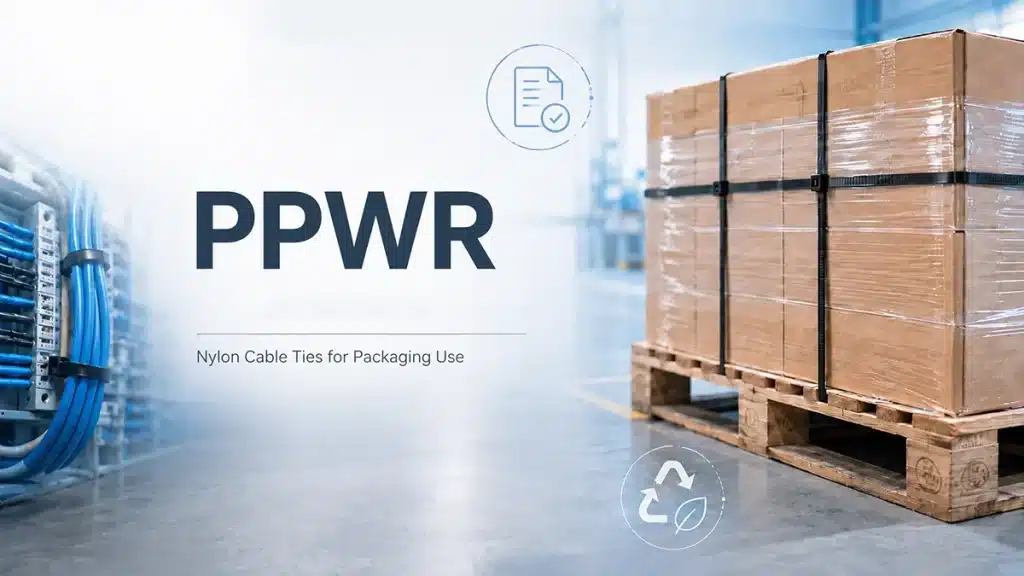
| Securing and stabilising goods on a pallet during transport | Transport packaging | ✅ |
The last two cases are where the distinction becomes particularly important.
For example, if a customer uses nylon cable ties to combine several products that could otherwise be sold separately, the tie is no longer being used for installation or cable management. Its function is to keep several sales units together as one grouped packaging unit.
The second clear example is pallet securing. If a tie is used to stabilise and protect goods on a pallet throughout transport, it is performing a transport-packaging function and needs to be considered under PPWR.
A practical question for cable tie manufacturers is therefore:
Does the tie remain on the product as a functional component, or is it used to group goods and secure them during packaging and transport?
The former is normally still a product. The latter needs to be assessed as packaging.
Once this is established, the next question is what PPWR actually requires when a nylon cable tie performs a packaging function.
4. What PPWR Requires When a Nylon Cable Tie Functions as Packaging
Once a nylon cable tie is confirmed to be performing a packaging function, the applicable PPWR requirements can be considered more systematically.
For a typical PA66 cable tie used as packaging, the main areas to review are:
| Requirement | Relevance to packaging-use nylon cable ties | Timing |
|---|---|---|
| Restricted substances | Pb, Cd, Hg and Cr(VI) limits need to be considered | Applies now |
| Recyclability | Basic recyclability requirements apply; the new Design for Recycling system will be phased in later | Basic requirement applies now; DfR later |
| Recycled plastic content | Minimum PCR content may apply in the future, subject to applicable exemptions | From 2030 or a later date specified by the regulation |
| Packaging minimisation | Weight and volume should be limited to what is necessary for the packaging function | From 2030 |
| Technical documentation and Declaration of Conformity | Material data, test results and assessments are needed to support conformity | Applies now |
For cable tie manufacturers, the immediate task is not to send every PPWR-related item to a laboratory.
A better approach is to identify which requirements actually apply to the intended use of the cable tie, and then prepare the relevant test reports, material documentation, and technical assessments.
4.1 Restricted Substances: Start with the Four Heavy Metals
PPWR Article 5 sets a combined concentration limit for four heavy metals in packaging and packaging components:
Pb + Cd + Hg + Cr(VI) ≤ 100 mg/kg
The important point here is that this is a combined limit.
This is different from the way RoHS limits are commonly assessed. RoHS establishes individual limits for different restricted substances, while PPWR looks at the total concentration of these four heavy metals.
Therefore, if an existing RoHS report is available, the cover-page result alone is not enough. The actual test results and method detection limits for Pb, Cd, Hg and Cr(VI) should also be reviewed.
For example, suppose a test report shows:
- Pb: ND (<2 mg/kg)
- Cd: ND (<2 mg/kg)
- Hg: ND (<2 mg/kg)
- Cr(VI): ND (<8 mg/kg)
Using the detection limits conservatively, the combined concentration would be below 14 mg/kg, providing strong supporting evidence against the PPWR limit of 100 mg/kg.
For nylon cable ties that have already undergone RoHS, ELV, or similar testing, it may therefore be unnecessary to repeat the same four measurements from the beginning.
A more practical approach is to review the existing data and confirm with the testing laboratory whether those results can be assessed against the PPWR Article 5 requirement.
Article 5 also makes clear that PPWR does not replace restrictions under REACH Annex XVII. A cable tie used as packaging must still comply with any REACH restrictions that apply to its material and intended use.
4.2 Recyclability Is More Than Saying “PA66 Can Be Recycled”
PPWR Article 6 requires packaging placed on the EU market to be recyclable.
For nylon cable ties, one common misunderstanding is to assume that because PA66 is a thermoplastic that can technically be re-melted and reprocessed, a PA66 cable tie automatically complies with PPWR recyclability requirements.
That conclusion is incomplete.
PPWR recyclability is not based only on whether a material can theoretically be recycled. It also considers whether packaging can realistically enter collection, sorting, and recycling processes, and whether its design affects the recyclability of the packaging unit as a whole.
Nylon Cable ties are typically small components. When used together with cartons, PE film, labels, or other packaging materials, removal, sorting, and recycling may need to be considered at the level of the complete packaging system rather than the cable tie alone.
The EU’s detailed Design for Recycling (DfR) criteria are still being developed.
Until the new Article 6 design-for-recycling requirements become applicable, current assessments can continue to refer to existing packaging recovery requirements and EN 13430:2004 — Packaging: Requirements for packaging recoverable by material recycling.
The new recyclability grading system will classify packaging into grades A, B and C. The Design for Recycling requirements will start to apply from 1 January 2030 or 24 months after the relevant delegated act enters into force, whichever is later.
For PA66 cable ties used as packaging, the practical approach at this stage is to document the material composition clearly and assess recyclability under the currently applicable framework rather than relying on a general statement that “PA66 is recyclable.”
4.3 Recycled Plastic Content Is a Requirement to Prepare for
PPWR Article 7 introduces minimum levels of post-consumer recycled plastic (PCR) for plastic packaging.
For other plastic packaging falling under Article 7(1)(d), the minimum PCR content is 35%. Other categories, including certain contact-sensitive packaging and single-use plastic beverage bottles, are subject to different percentages.
This is not an immediate 2026 obligation.
Under Article 7(1), the requirement will apply from 1 January 2030 or three years after the implementing act referred to in Article 7(8) enters into force, whichever is later.
This is an area cable tie manufacturers should start monitoring in advance.
Industrial nylon cable ties are commonly produced from virgin PA66 because material quality directly affects:
- tensile strength;
- locking performance;
- toughness;
- low-temperature performance;
- long-term stability.
If packaging-use PA66 cable ties eventually need to contain a certain percentage of PCR material, the formulation will need to be revalidated to confirm that the tie still meets its required tensile and locking performance.
PPWR also provides a relevant exemption for a low-weight plastic part.
If a plastic part represents less than 5% of the total weight of the entire packaging unit, the minimum recycled-content requirements under Article 7(1) and (2) may not apply to that plastic part.
For nylon cable ties, however, this exemption should not be assumed simply because the tie itself is lightweight.
It is first necessary to determine whether the tie is an independent packaging unit or a plastic component within a larger packaging unit. The relevant weight and packaging-structure information should also be retained in the technical documentation.
Therefore, there is no reason to replace virgin PA66 with 35% recycled PA66 immediately simply because a cable tie may be used as packaging.
The more appropriate approach is to determine the packaging structure, establish the tie’s role within that structure, and confirm whether Article 7 applies before deciding on a future material strategy.
4.4 Packaging Minimisation Does Not Simply Mean Using a Smaller Tie
PPWR does not only regulate what packaging is made from. It also addresses how much packaging material is used.
Article 10 requires, from 2030, packaging weight and volume to be reduced to the minimum necessary to perform the packaging function.
For a cable tie used in transport securing, this does not mean selecting the thinnest or shortest possible tie.
The tie still needs to:
- be installed correctly;
- provide sufficient bundling length;
- achieve the required tensile strength;
- remain secure throughout transport without loosening or breaking.
What should be avoided is using a cable tie that is substantially wider, longer, or heavier than the application requires without a functional reason.
Packaging minimisation is therefore not simply about reducing the product specification. It is about being able to demonstrate that the selected specification is appropriate for the fastening, protection and transport function it needs to perform.
4.5 Pallet-Securing Ties May Also Be Affected by Reuse Targets
If a nylon cable tie is used in a packaging system as a strap for stabilising and protecting goods on a pallet, an additional PPWR requirement may need to be considered: reuse targets for transport packaging.
PPWR Article 29 explicitly refers to straps used for the stabilisation and protection of products placed on pallets during transport.
From 2030, economic operators using these types of transport packaging within the EU will need to meet reuse targets depending on the specific transport scenario.
This means that a cable tie used for one-time pallet securing may eventually raise more than material and recyclability questions. Its use may also need to be considered within a reusable transport-packaging system.
However, these obligations primarily apply to the economic operators using the transport packaging. The exact requirements depend on factors such as transport scope, relationships between the parties, and exemptions provided in the regulation.
For a cable tie supplier, the practical priority is therefore to understand the customer’s actual transport application rather than assuming that every cable tie used in packaging must itself be reusable.
5. Can Existing RoHS and REACH Reports Support PPWR Compliance?
This is a common question for both buyers and suppliers.
The answer is:
Yes, existing reports can provide useful supporting evidence, but they do not automatically demonstrate full PPWR compliance.
RoHS Reports: Look at the Actual Test Data
If a RoHS report was issued for the cable tie actually being supplied and includes Pb, Cd, Hg, and Cr(VI), those results may support the PPWR Article 5 heavy-metal assessment.
However:
RoHS Compliant
does not automatically mean:
PPWR Compliant
The two regulations use different compliance criteria.
For PPWR purposes, the most useful information in an existing RoHS report is therefore the actual test result, the method detection limit, and the testing method — not simply the overall PASS result.
REACH SVHC: A Separate Chemical Compliance Requirement
REACH Candidate List SVHC screening is also valuable supporting information, but it addresses REACH obligations relating to substances of very great concern.
It does not replace the PPWR Article 5 heavy-metal requirement.
Likewise, REACH SVHC screening and REACH Annex XVII are not the same thing.
Annex XVII is a restriction list. Different substances are subject to different restrictions depending on the product, material, use, and applicable conditions.
For a PA66 cable tie, the more appropriate approach is to identify which Annex XVII restrictions are relevant to the material and intended use rather than automatically testing against every entry in Annex XVII.
The relationship between the main compliance documents can be summarised as follows:
| Document or assessment | Main purpose |
|---|---|
| PPWR Article 5 heavy-metal data | Supports the combined Pb/Cd/Hg/Cr(VI) assessment |
| REACH SVHC screening | Identifies Candidate List SVHC status |
| REACH Annex XVII assessment | Determines which restrictions apply to the PA66 cable tie |
| Material declaration | Describes PA66, colourants and relevant material composition |
| Recyclability assessment | Supports the applicable Article 6 recyclability requirements |
| PPWR technical documentation | Brings the supporting evidence together for the conformity assessment |
These documents complement each other. They should not be treated as interchangeable certificates.
6. PPWR Compliance Goes Beyond a Test Report
This is one of the main differences between PPWR compliance and simply carrying out an environmental test.
PPWR requires the manufacturer in the regulatory sense to compile technical documentation and complete the applicable conformity assessment before placing packaging on the market.
The regulatory manufacturer is not necessarily the company that physically moulds or produces the cable tie. Responsibility can depend on how the packaging is designed, branded, and placed on the EU market.
Under Annex VII, the technical documentation should include, where relevant:
- a description of the packaging and its intended use;
- design and manufacturing information;
- materials used in the relevant components;
- standards or technical specifications applied;
- descriptions of the relevant conformity assessments;
- supporting test reports.
For a nylon cable tie used as packaging, the documentation process can be viewed as:
Confirm the intended application
→ Collect material and BOM information
→ Determine which PPWR and other legal requirements apply
→ Carry out the necessary testing and assessments
→ Assess recyclability and other applicable technical requirements
→ Compile the Technical Documentation
→ Issue the EU Declaration of Conformity
PPWR Annex VII uses Module A — Internal Production Control.
The manufacturer must ensure that production remains consistent with the technical documentation and takes responsibility for demonstrating that the packaging complies with the applicable requirements.
Once conformity has been demonstrated, the EU Declaration of Conformity is drawn up using the structure provided in Annex VIII. It identifies the packaging, the manufacturer, the applicable legislation, and the standards or technical specifications relied upon.
For single-use packaging, the technical documentation and Declaration of Conformity must be retained for five years.
PPWR compliance is therefore better understood as a complete system of:
material information + test data + technical assessment + document management
rather than a single “PPWR test report.”
7. What Should Cable Tie Manufacturers and Buyers Confirm?
For nylon cable ties intended for packaging applications, one of the most important steps is to clarify the intended use at the beginning of the project.
Buyers should provide information such as:
- Where will the cable tie be used?
- Will it combine several products into one grouped unit?
- Will it secure goods on a pallet during transport?
- Will it be removed when the packaging is opened?
- What proportion of the overall packaging weight does it represent?
- Are there specific colour, flame-retardant, weather-resistant, or low-temperature requirements?
The supplier should then confirm whether the material formulation and available compliance documentation actually cover that specific application.
Different cable tie formulations should not automatically be covered by the same test report.
For example:
- natural PA66;
- black PA66;
- flame-retardant PA66;
- weather-resistant PA66;
- low-temperature-modified PA66.
Although all of these products may be described as nylon cable ties, the colourants and additives used can differ.
If a test report was issued for a standard natural-colour PA66 cable tie, it should not automatically be assumed to cover every colour and modified formulation without further material justification.
This is why, when dealing with PPWR, confirming the actual material and final application is often more important than sending a sample for testing first.
Conclusion
PPWR has not turned every nylon cable tie into a packaging product.
For cable management, vehicle wiring harnesses, equipment installation, and other general fastening applications, nylon cable ties remain fastening products or product components.
The nylon cable ties that require closer PPWR attention are those that actually perform a packaging function, such as grouping sales units or securing goods during transport.
Once a nylon cable tie forms part of packaging placed on the EU market, compliance cannot simply be reduced to obtaining one “PPWR test report.”
Restricted substances, recyclability, future recycled-content requirements, packaging minimisation, technical documentation, and the EU Declaration of Conformity each involve different evidence and different implementation timelines.
For both suppliers and buyers, the most practical order is therefore:
Confirm the intended use first, determine which requirements apply second, and prepare the relevant testing and technical documentation last.
This helps avoid overlooking requirements that genuinely apply — while also avoiding unnecessary testing for requirements that do not.