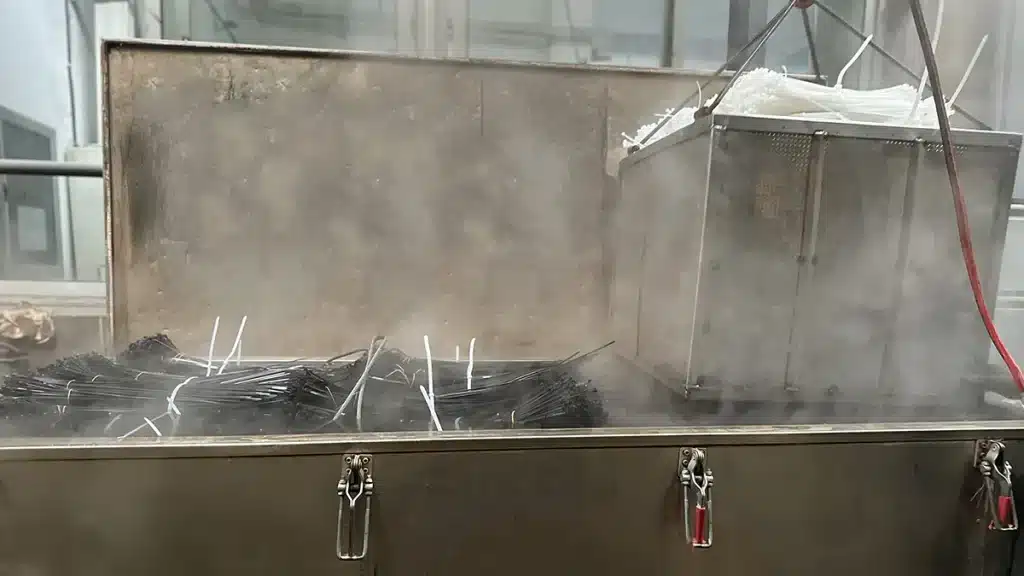
Walk into a nylon cable tie factory, and you may notice something unusual: freshly molded nylon cable ties are packed into metal baskets and lowered into a warm-water tank, with light steam rising above the surface.
At first glance, it may look like the ties are being washed. In fact, this is a common post-molding process for PA66 nylon cable ties known as moisture conditioning.
Freshly molded cable ties are extremely dry. In this condition, PA66 is relatively stiff and brittle, especially when sharply bent. Moisture conditioning allows the material to absorb a controlled amount of water, improving flexibility and reducing the risk of breakage during installation.
Why Are Freshly Molded Nylon Cable Ties More Brittle?
PA66 is one of the most commonly used materials for nylon cable ties, and it must be thoroughly dried before injection molding.
Nylon is hygroscopic, meaning it readily absorbs moisture from the surrounding air. If the raw material contains too much moisture during high-temperature processing, it can affect the condition of the polymer and lead to molding problems.
After drying, melting, and injection molding, the finished cable tie comes out of the mold with a very low moisture content. At this stage, it feels noticeably harder than a properly conditioned tie and has less flexibility. If bent sharply, it may crack or even break.
This does not necessarily indicate a problem with the raw material. PA66 naturally becomes stiffer and less flexible when its moisture content is very low.
That is why molding is not the final step. After the ties leave the mold, their moisture level needs to be brought back into a suitable range.
What Does Hot-Water Conditioning Actually Do?
PA66 naturally absorbs moisture from its surroundings. If freshly molded nylon cable ties are left in the air, they will gradually absorb moisture, but the rate depends heavily on temperature, humidity, and season.
That makes natural conditioning difficult to control in production.
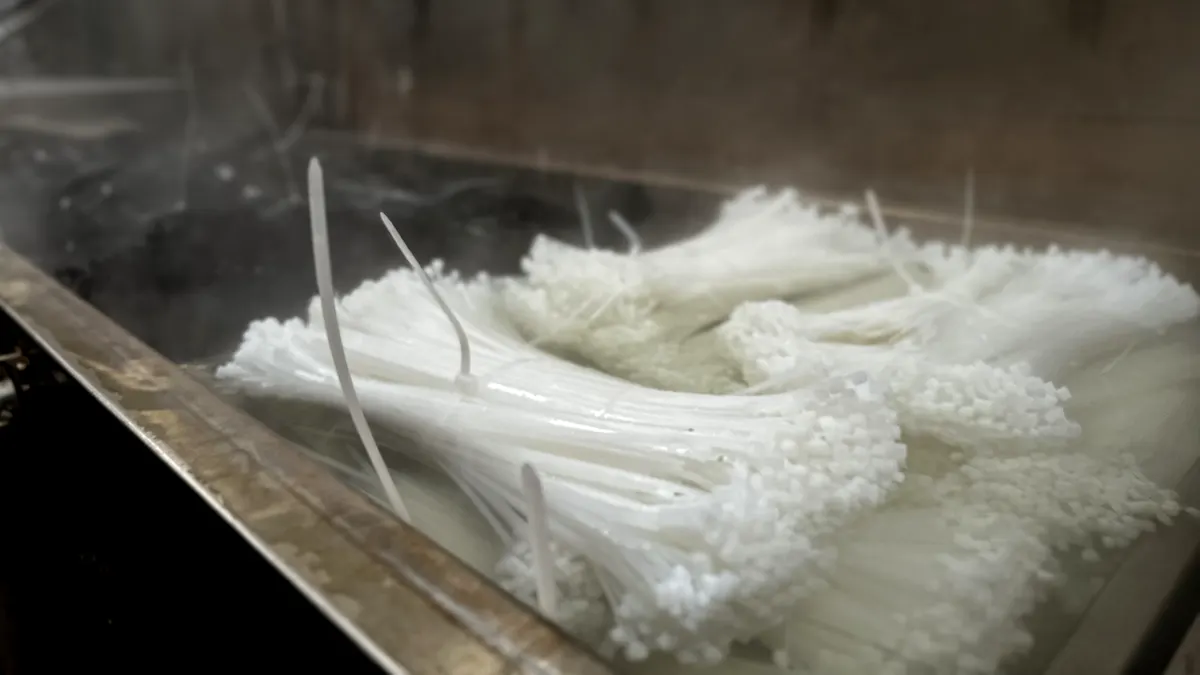
Warm-water conditioning speeds up the process and makes the result more consistent.
In the factory, this step is often referred to as “boiling the ties,” but the water is not actually boiling. At HUADA, the temperature is usually kept at around 40°C — warm enough to speed up moisture absorption without using excessively high temperatures.
How long the ties stay in the water depends mainly on their size. Small nylon cable ties have thinner cross-sections, so moisture can penetrate relatively quickly. Some may need only around ten minutes. Larger and thicker ties absorb moisture more slowly and may remain in the tank for close to an hour.
As water enters PA66, it affects the interactions between the polymer chains. PA66 contains amide groups that form strong intermolecular hydrogen bonds. In a very dry state, these interactions contribute to the material’s relatively high stiffness. Absorbed water reduces some of these interactions and allows the molecular chains to move more easily.
The result is a cable tie with better flexibility and toughness.
For cable ties, this matters during actual installation. The strap must bend around wires, cables, pipes or other objects before being curved back and inserted into the locking head. This requires significant bending deformation. If the PA66 remains extremely dry, the tie is more likely to crack during this process.
Does More Moisture Always Make a Better Cable Tie?
No. Moisture conditioning is about finding the right balance.
As PA66 absorbs water, it becomes more flexible, but its stiffness and other mechanical properties also change. In general, higher moisture content improves toughness and elongation, while stiffness and tensile strength may decrease.
If a cable tie is under-conditioned, it may remain too dry and too stiff, increasing the risk of cracking during bending. If it absorbs too much moisture, however, it can become overly soft and its mechanical performance may also be affected.
Seasonal conditions make this more complicated.
During hot summer months, cable ties may already show slightly lower tensile performance because of the higher ambient temperature. For some smaller sizes, putting them through a full warm-water conditioning cycle may reduce tensile strength more than necessary.
In such cases, we may use a different method. Instead of placing certain small ties in the conditioning tank, a controlled amount of water — typically around 2% of the cable tie weight — can be added during packing. After the bag is sealed, the ties gradually absorb moisture inside the package.
This is one reason cable ties made from similar grades of PA66 can still feel different in actual use. Raw material is only one part of the equation. Injection molding conditions, mold condition and post-molding moisture conditioning all influence the final product.
Why Are Nylon Cable Ties Packed in Sealed Bags After Conditioning?
PA66 can absorb moisture, but it can also lose it.
If conditioned cable ties are left for a long time in a dry environment, moisture gradually leaves the material. Over time, the ties can become harder and less flexible again.
Sealed plastic packaging helps slow down this moisture exchange. Besides keeping the product clean and convenient for storage and transport, the bag also helps maintain a more stable moisture level.
This is also how the water-added packaging method works in summer. Once the bag is sealed, the humidity inside remains relatively high, allowing the cable ties to absorb the added moisture gradually.
After opening a bag, unused cable ties should therefore be resealed if they are not going to be used immediately, especially in dry environments.
Cable ties may also feel harder in winter. Lower temperatures naturally reduce the flexibility of PA66, while dry winter air can cause the material to lose moisture at the same time. When both factors occur together, the difference can become quite noticeable during installation.
Moisture conditioning and low-temperature resistance, however, are not the same thing.
Conditioning helps prevent standard PA66 cable ties from becoming excessively dry and brittle. If cable ties need to be installed or used at particularly low temperatures, a specially formulated low-temperature-resistant cable tie is still the more appropriate choice.
Moisture Conditioning Is Part of Cable Tie Manufacturing
When cable ties drop out of an injection mold, it may look as though production is already complete. In reality, several important steps still follow.
PA66 resin is first dried and then injection molded. After molding, the cable ties go through moisture conditioning, inspection, and packaging before they are ready for shipment.
Lowering baskets of cable ties into warm water may look like a simple step, but it directly affects the flexibility and handling characteristics of the finished product.
At HUADA, conditioning parameters are adjusted according to cable tie size and production conditions. Finished products are also checked through bending, tensile, and other inspections to help keep flexibility and mechanical performance stable.
For users, storage matters as well. Once a bag has been opened, unused nylon cable ties should be resealed and stored at normal room temperature, away from direct sunlight and excessively dry conditions.
For PA66 nylon cable ties, injection molding is not the last step. Moisture conditioning is an important part of the process, helping turn a freshly molded, very dry tie into a product with the flexibility needed for reliable installation.