Whether nylon cable ties are corrosion-resistant depends on where they are used. A laundry room, a ship, and a chemical workshop may all be called “corrosive environments,” but the real factors are very different. The problem may be oxidizing cleaners, UV light, salt spray, strong acids, strong alkalis, or organic solvents.
So the real question is not simply “Can nylon cable ties resist corrosion?” The real question is: what are they touching, how hot is the environment, how long is the exposure, and are there other factors like moisture, UV, salt spray, or mechanical stress?
Below are three common situations. They show where standard nylon cable ties may have problems, when stainless steel ties make more sense, and when materials like PVDF or PFA should be considered.
1. What does “corrosion resistance” mean for nylon cable ties?
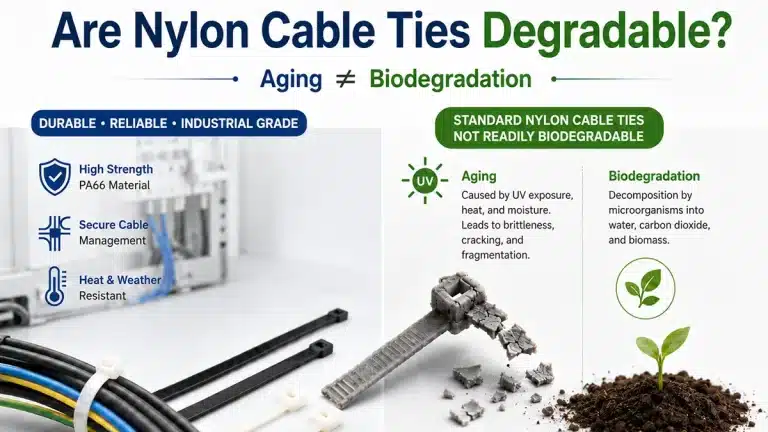
When people hear “corrosion resistance,” they often think about metal rusting. But nylon cable ties are not metal. Their problem is not rust. Their problem is material aging, degradation, and loss of performance after contact with certain substances. In corrosive environments, nylon cable ties usually fail in these ways: discoloration, brittleness, cracking, and lower tensile strength.
That is why different “corrosive environments” can give very different results. In normal damp conditions, nylon cable ties often work well. But if they are exposed for a long time to strong oxidizers, strong acids, strong alkalis, high heat, UV light, or salt spray, aging becomes much faster.
For buyers and engineers, the key is not to ask “Are nylon cable ties corrosion resistant?” in a general way. The key is to ask what chemical they touch, how strong it is, how hot it is, and how long the exposure lasts.
2. Scenario 1: Laundry rooms and disinfection areas — chlorine-based cleaning environments
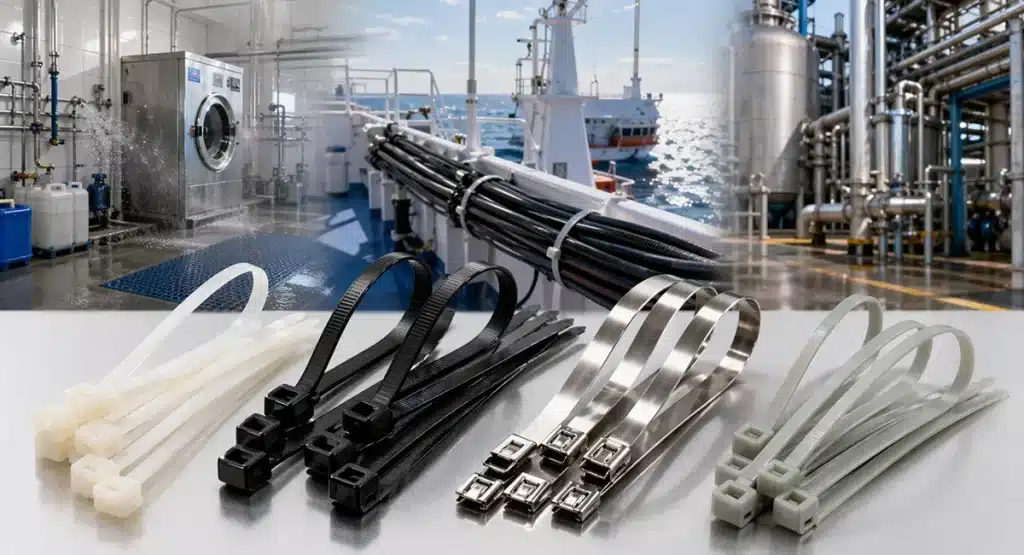
In laundry rooms and disinfection areas, the problem is not just moisture. The bigger issue is repeated contact with chlorine-based cleaners, alkaline detergents, hot water, and steam. When these factors come together, standard nylon cable ties can age much faster.
If this is only a normal home laundry setting, and the tie is not in direct long-term contact with cleaning chemicals, standard PA66 nylon cable ties can usually still be used. But in dry cleaners, commercial laundries, disinfection rooms, or food cleaning areas, the situation is different. In these places, chlorine cleaners and bleaching agents are used more often and in stronger concentrations.
2.1 What can happen to standard nylon cable ties?
In chlorine-based and alkaline cleaning environments, standard PA66 cable ties are more likely to age and lose performance. This becomes worse when hot water, steam, or constant dampness is also present.
Common signs include: yellowing or darkening, brittleness, sudden breakage when bent, lower tensile strength, and shorter service life
These changes usually do not appear immediately. They show up gradually over time. That is why regular inspection and replacement are important in long-term fixing points.
2.2 Is stainless steel a better choice?
Stainless steel cable ties are more corrosion-resistant, but they are not always the best choice in laundry areas. If the fixing point is close to clothing, fabric, or soft hoses, poorly finished stainless steel edges or buckle areas may scratch or catch the material.
So stainless steel ties are usually more suitable for pipes, machine edges, cable trays, and structural fixing points.
If a metal tie is needed, 316 stainless steel is usually a better choice than 304 in this type of chlorine-based environment.
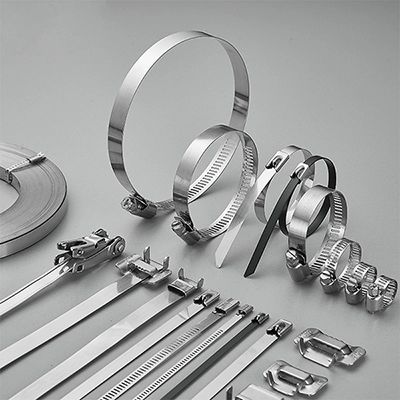
Selection advice: General fixing points: standard PA66 ties can still be used, but regular inspection and replacement are recommended. Areas with frequent cleaning and stronger chemical exposure: 316 stainless steel is usually a better choice. More severe chemical environments or places with higher life requirements: PVDF or PFA may be considered
So in this type of environment, material choice is not only about corrosion resistance. It also depends on the strength of the environment, the installation position, the importance of the fixing point, and the maintenance plan.
3. Scenario 2: Ships and offshore platforms — salt spray and strong UV exposure
When people think about ships and offshore platforms, they usually think first about salt spray and seawater. But for nylon cable ties, the real issue is often a combination of salt, UV light, moisture, temperature changes, and oil mist. Together, these factors can age the material much faster than in a normal outdoor setting.
If the tie is installed inside an engine room, inside a tray, or in a more enclosed area, the main issues are moisture, oil mist, and some salt exposure. These conditions are harsher than normal indoor use, but they do not always require specialty materials. However, if the tie is installed on the deck, outside the hull, or near outdoor equipment, then standard nylon ties should no longer be treated like normal outdoor-use products.
3.1 What can happen to standard nylon cable ties in marine environments?
For standard PA66 nylon cable ties, the problem is not just dampness. It is aging caused by UV light, salt spray, and temperature changes.
Common signs include: whitening and loss of surface gloss, increasing brittleness, reduced tensile strength, and breakage after a period of use
Standard nylon ties usually age much faster under long-term outdoor exposure. Salt spray speeds up damage after the surface has already started aging, while UV light is often the more direct cause of material breakdown. So in marine environments, it is not enough to ask whether a tie is “corrosion resistant.” It must also be able to survive long outdoor exposure.
3.2 When are stainless steel cable ties more suitable?
If the fixing point is near the sea, on the deck, outside the hull, or in a high salt spray area, stainless steel ties are usually the safer option.
In many cases:
304 stainless steel is enough for internal ship areas, engine rooms, and cable trays. 316 stainless steel is a better choice for long-term seawater contact, higher chloride exposure, or more severe marine conditions
This does not mean every ship application must use 316 from the start. But for critical points with long exposure and heavy salt spray, 316 is usually the preferred option.
3.3 How to choose in marine environments?
Inside engine rooms, trays, or semi-enclosed areas: standard PA66, UV-resistant nylon, or 304 stainless steel may all be considered depending on the environment. Deck, outside hull, or outdoor fixing points: prioritize UV-resistant nylon cable ties or stainless steel cable ties Long-term seawater contact, heavier salt spray, or higher life requirements: 316 stainless steel is usually more suitable
Standard nylon ties are not completely unusable in marine environments, but they should not simply be treated like normal outdoor-use products. If the fixing point is exposed to sunlight, sea wind, and salt spray for a long time, UV-resistant nylon or stainless steel is usually the safer direction.
4. Scenario 3: Chemical plants and industrial workshops — first identify the chemical
A common customer question: “Our workshop has acidic gas, and sometimes sulfuric acid as well. Can we still use nylon cable ties?”
4.1 Where is the real problem?
Chemical environments are very different from the first two scenarios because there is no single answer. Hydrochloric acid, sulfuric acid, sodium hydroxide, ammonia solution, ketones, and esters all affect materials in different ways. So in this kind of environment, the first step is not to ask “Can nylon cable ties be used?” The first step is to clearly identify what chemical is present.
4.2 Acidic environments
If the tie is exposed to acids, standard PA66 nylon ties should not be treated as if they are in a normal industrial environment. In weak acid conditions, short-term use may still be possible. But in strong acid, acid mist, or long-term acidic vapor exposure, the risk of aging and degradation increases significantly.
PP cable ties can be one step above standard PA66 here. In general, in acid and alkali conditions, PP usually performs better than standard nylon, and it costs less than PVDF or PFA. So in moderately acidic environments, PP can be a practical option.
But PP also has limits. It is usually not the first choice when the temperature is higher, the fixing point carries more load, and the environment is more severe
If the acid is stronger or the fixing point is more critical, stainless steel ties usually come into the picture. One important point: if the environment involves hydrochloric acid or hydrofluoric acid, stainless steel must be treated carefully. In many such cases, PVDF or PFA is the safer direction. For acids like sulfuric acid or nitric acid, the final choice still depends on concentration, temperature, and contact conditions.
4.3 Alkaline environments
In strong alkali environments, standard nylon ties are also not the preferred option. If the workshop is exposed for a long time to sodium hydroxide, ammonia solution, or similar chemicals, PP ties are often more resistant than standard PA66, especially where the temperature is not high, and the mechanical strength requirements are not too demanding.
If the fixing point needs more strength, better stability, or longer service life, stainless steel is often more common and more economical. Both 304 and 316 can work in many alkaline environments. If the chemical environment is more complex, PVDF or PFA may then be considered.
4.4 Organic solvent environments
If the workshop is exposed for a long time to aromatic solvents, ketones, esters, or other organic solvents, standard nylon cable ties should be used carefully. PP is also usually not recommended in these cases, because even though it handles acids and alkalis better than standard nylon, it is not always stable in complex solvent environments.
In practice, stainless steel ties are more common here because they are more stable in many solvent environments. If the chemical mix is more complex or if a longer service life is required, PVDF or PFA may be more suitable. In general, the more complex the chemicals are, the less suitable it is to stay only at the level of standard nylon or PP.
4.5 How to judge these environments?
In chemical plants and industrial workshops, the most important thing is not to choose a material first. The first step is to clarify:
What chemical is present, the approximate concentration, the temperature range, whether the contact is short-term or long-term, whether there is acid mist, steam, or solvent vapor nearby
Once this information is clear, it becomes much easier to decide between standard nylon, PP, stainless steel, PVDF, or PFA.
5. Quick comparison table
| Application | Main Risk Factors | PA66 | PP | UV PA66 | 304 SS | 316 SS | PVDF / PFA |
| Normal indoor environment | No obvious corrosion | ✅ | — | — | ✅ | ✅ | — |
| General damp environment | Moisture, condensation | ✅ | ✅ | ✅ | ✅ | ✅ | — |
| Laundry / disinfection area | Chlorine cleaners, alkaline detergents, and heat | ⚠️ | ⚠️ | ⚠️ | ⚠️ | ✅ | ✅ |
| Ship engine room / internal tray | Moisture, oil mist, and some salt spray | ⚠️ | ❌ | ✅ | ✅ | ✅ | — |
| Ship deck / exposed marine area | UV, salt spray, temperature changes | ❌ | ❌ | ✅ | ✅ | ✅ | — |
| General acid/alkali workshop | Acid/alkali exposure, steam | ⚠️ | ✅ | ❌ | ✅ | ✅ | ✅ |
| Strong acid / strong alkali | Severe chemical exposure | ❌ | ⚠️ | ❌ | ⚠️ | ⚠️ | ✅ |
| Hydrochloric/hydrofluoric acid | Halide-containing acids | ❌ | ⚠️ | ❌ | ❌ | ❌ | ✅ |
| Organic solvent environment | Aromatic solvents, ketones, esters, etc. | ❌ | ❌ | ❌ | ✅ | ✅ | Laundry/disinfection area |
6. Conclusion
Standard PA66 nylon cable ties are not completely non-corrosion-resistant. In normal indoor environments, general damp conditions, and some weak acid or weak alkali situations, they can usually still be used. But once the environment starts to involve chlorine-based cleaners, strong acids, strong alkalis, strong UV exposure, heavy salt spray, or organic solvents, material selection needs more attention.
PP, UV-resistant nylon, stainless steel, PVDF, and PFA are not interchangeable — each one suits a different level of environmental severity. The real issue is not picking the most expensive material. It is matching the material to what the environment actually demands.
If you are not sure which direction to go, start by identifying the chemical name, the temperature range, and whether the exposure is short-term or long-term. That information will narrow things down much faster than asking whether nylon cable ties are “corrosion resistant” in a general sense.