“Are nylon cable ties degradable?” and “Are nylon cable ties environmentally friendly?” are two questions we have received more often from customers recently.
At first glance, they may sound similar. In fact, they refer to two different things. One question is about whether the material can break down in nature. The other is about whether the product is safe, compliant with environmental regulations, and suitable for long-term use without causing unnecessary waste.
Many people confuse aging, degradation, and environmental compliance. This can make it difficult to give a clear answer when selecting cable ties or responding to customer requirements.
This article explains the issue from the material side.
Are Nylon Cable Ties Environmentally Friendly?
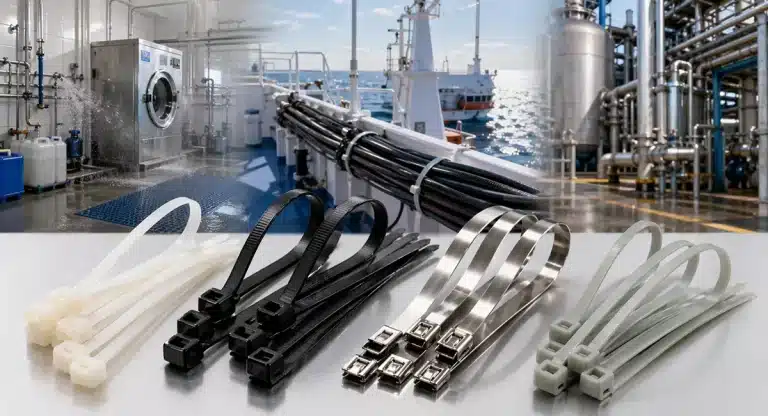
Most nylon cable ties are made of polyamide 66, commonly known as PA66. It is a mature engineering plastic widely used in electrical installation, automotive wiring, mechanical equipment, packaging, and general fastening applications.
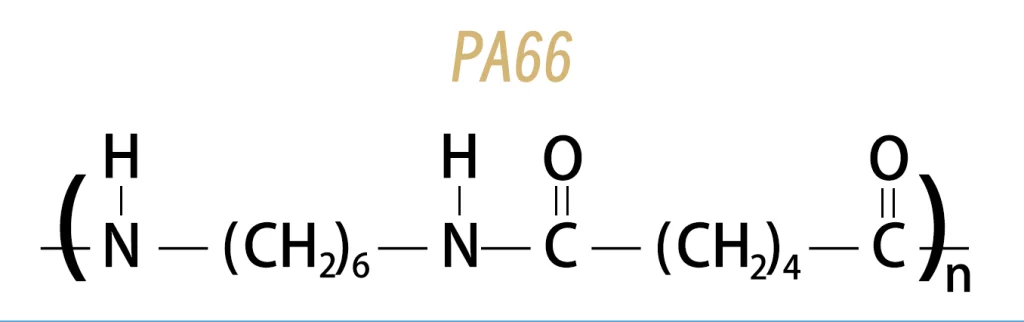
From a material safety perspective, qualified PA66 nylon cable ties can be produced and tested to meet requirements such as RoHS and REACH. Relevant test reports can also be provided upon customer request.
In other words, whether a nylon cable tie is “environmentally friendly” should not be judged only by the material name. It should also depend on whether the finished product meets the required testing standards and compliance requirements.
Environmental responsibility is not only about whether a product can degrade. For fastening products like cable ties, durability also matters.
A properly selected, good-quality nylon cable tie can hold cables or components securely for a long time in indoor, normal-temperature, or relatively stable environments. On the other hand, low-quality cable ties may age, crack, or break too early, leading to frequent replacement, more material consumption, and higher maintenance costs.
From a practical point of view, the more responsible choice is not simply to look for a “degradable cable tie,” but to choose the right product for the right environment and reduce waste caused by poor selection.
Are Cable Ties Degradable?
Standard PA66 nylon cable ties are not classified as rapidly biodegradable materials.
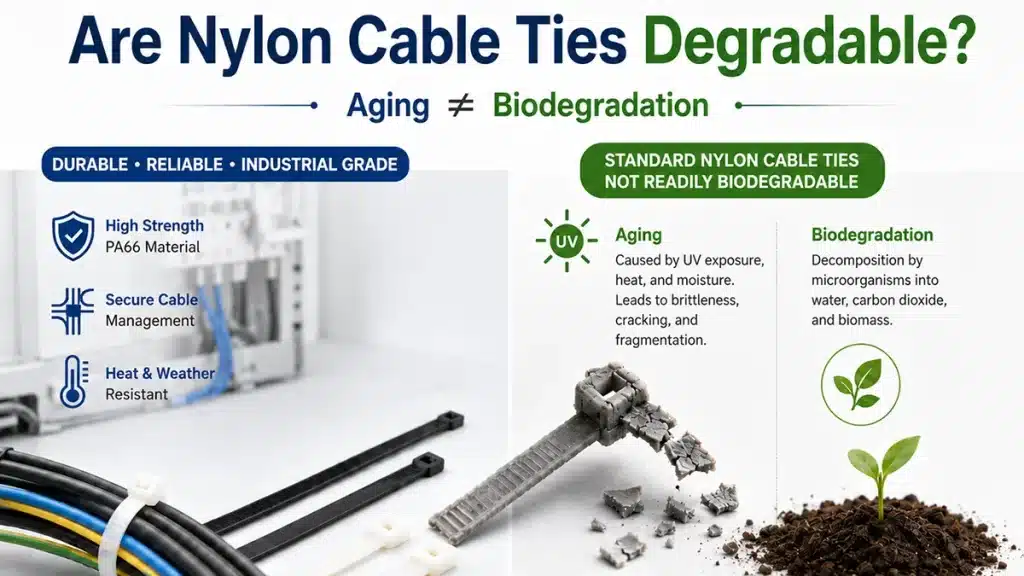
Some people see outdoor cable ties becoming brittle or breaking after long exposure to sunlight and assume that they have “degraded.” Strictly speaking, this is usually material aging, not true biodegradation.
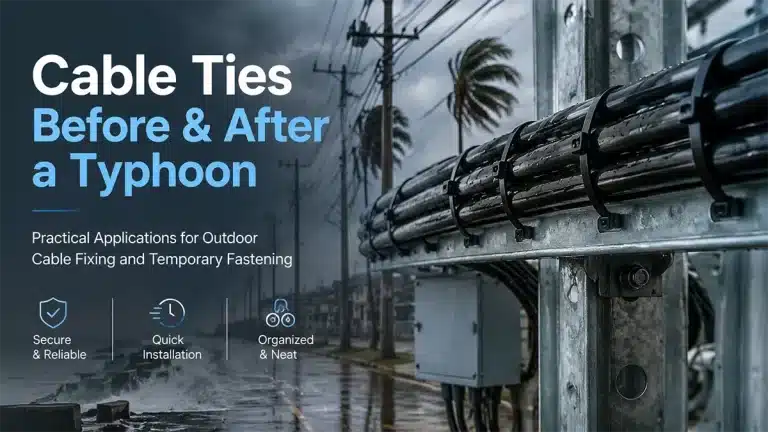
When nylon cable ties are used outdoors, they are exposed to UV radiation, heat, moisture, and oxygen. These factors may cause photo-oxidation, damage the polymer chains, reduce tensile strength, and eventually lead to brittleness, cracking, or breakage.
In many cases, aged plastic only breaks into smaller fragments. It is still plastic, just in smaller pieces.
The key distinction is simple: Aging is not the same as biodegradation.
What Does “Degradable” Really Mean?
A simple marketing claim cannot define true biodegradability or industrial compostability. It needs to be supported by clear testing standards and third-party certification.
Standards such as ISO 17088 and EN 13432 involve several evaluation items, including biodegradation rate, disintegration, ecotoxicity, and control of harmful substances. If a plastic product is claimed to be “biodegradable” or “compostable,” there should be corresponding test data and certification to support the claim.
For standard PA66 nylon cable ties, the main design focus is tensile strength, locking performance, heat resistance, and service life. They are not designed to break down quickly in the natural environment and should not be promoted as rapidly biodegradable products.
There are also products on the market that claim to be “degradable” by adding pro-oxidant additives. In most cases, these additives only accelerate oxidation and fragmentation of the plastic. This is not the same as complete biodegradation by microorganisms. Buyers should evaluate such claims carefully.
Summary
Standard PA66 nylon cable ties are safe, durable, and widely used engineering plastic products. Qualified products can meet environmental compliance requirements such as RoHS and REACH.
However, they are not rapidly biodegradable materials. Outdoor aging, brittleness, or breakage should not be mistaken for true biodegradation. Whether a nylon cable tie is “environmentally friendly” cannot be reduced to a single question of degradability.
For buyers and users, the more practical approach is to choose the right type of cable tie for the actual working environment. This helps avoid premature failure, reduce frequent replacement, and minimize unnecessary waste.
If you need certification documents or product recommendations for a specific application, please contact us.