Cable ties are no longer only industrial products. Today, they can also be found in supermarkets, hardware stores, home goods shops, and even general retail shelves. Unlike industrial cable ties, which are usually bought in bulk and selected by performance, cable ties sold in retail stores show a different pattern. They focus more on retail packaging, common sizes, and quick buying decisions.
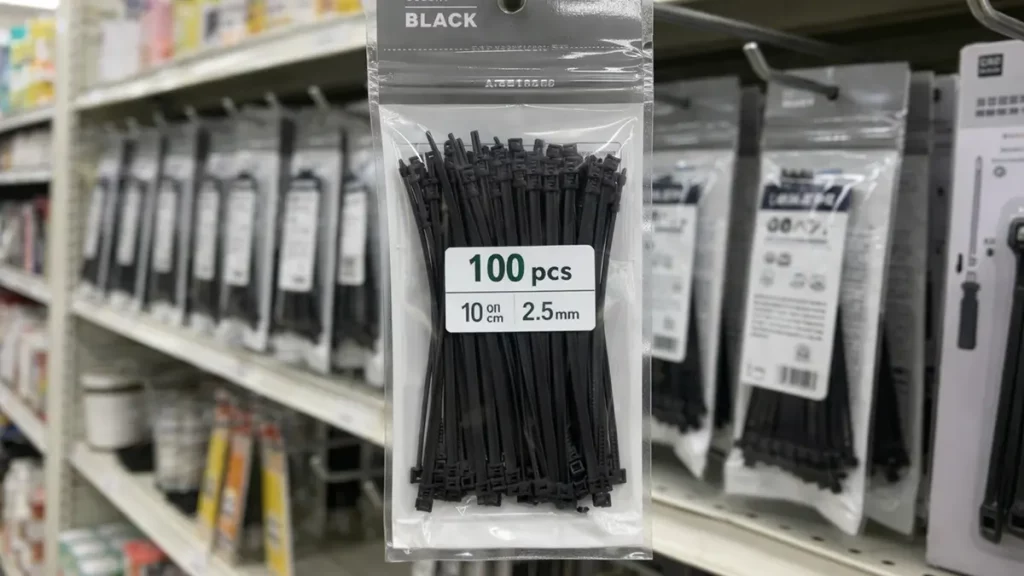
This article looks at the common packaging, colors, sizes, and retail features of cable ties sold in stores, and also explains how retail nylon cable ties differ from industrial cable ties.
1. Why are cable ties sold in retail stores?
Cable ties were first used more in aerospace and industrial wire management, not as retail products. But over time, their use expanded far beyond factories and engineering work. Today, they are also used in homes, small shops, and other light-duty everyday situations.
Most retail buyers do not think about things like certifications, tensile strength, or technical grades the way industrial buyers do. But they do have regular needs for bundling, organizing, cable management, and quick fixing. Cable ties are low-cost, easy to understand, and easy to use, which makes them a good fit for retail shelves.
Because retail cable ties are mainly sold for quick use and light-duty needs, they are usually different from industrial cable ties in packaging, size selection, and the way product information is shown.
2. Common packaging types for cable ties in retail stores
One of the easiest differences to notice on a retail shelf is the packaging. Industrial cable ties are often packed in large bags, bulk packs, or cartons. Retail cable ties are different. They are designed for display, easy comparison, and single-pack sales. For buyers, different packaging types also mean different packaging costs, labor input, printing methods, and minimum order quantity requirements.
Here are some of the most common retail packaging types for cable ties.
2.1 Header card packaging
Header card packaging was very common in retail a few years ago. It gives a larger display area, so brand name, size, color, quantity, barcode, and other basic information can all be shown clearly on the card. It also stands out well on the shelf.
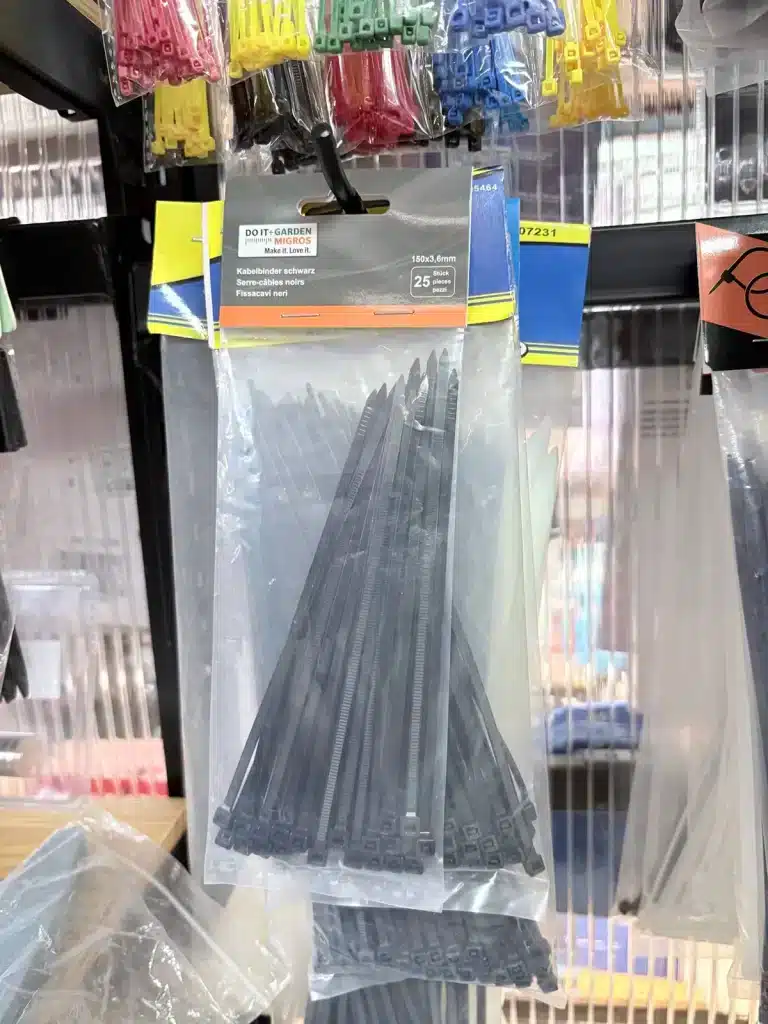
But this type of packaging usually costs more than just the paper card itself. It often involves stapling, sealing, or manual packing work. If it is assembled by hand, labor cost can become a bigger part of the total packaging cost. In other words, header card packaging has a strong retail look, but it usually comes with higher packaging and labor costs than simple bulk packing.
2.2 Printed bags with hang holes
Printed plastic bags with hang holes have become a very common retail format in recent years. They are also made for hook display, but compared with header cards, they are lighter and usually look cleaner on the shelf. Brand name, size, quantity, and color can all be printed directly on the bag.
A key point here is that printed bags usually require a certain order quantity. They are not always ideal for very small packaging runs. For buyers and suppliers, this type of packaging means the bag has to be designed and printed first, so there is a preparation cost behind what looks like a simple retail pack.
2.3 Resealable bags
Resealable bags are often used for slightly larger home-use packs, backup packs, or mixed sets, especially in mass retail and supermarket-style channels such as Walmart and similar large-format stores. Their main advantage is that after the customer opens the pack, the remaining cable ties can still be stored inside. This makes them more practical for daily use at home.
However, resealable bags usually cost more than standard printed bags. The zipper structure adds material and processing cost. For small retail packs with a low product value, the packaging cost can become quite noticeable. If custom printing is also needed, the minimum order quantity becomes another factor to consider.
2.4 Buckets or boxes
Buckets and boxes are less common than bag packaging, but they do appear in some tool sections, storage sections, and home organization areas. They are more suitable for larger quantities and for products meant to be kept at home for longer-term use.
This type of packaging usually costs more. The bucket or box itself is more expensive than a bag, and filling, labeling, and extra packing steps also increase labor costs. Because of that, buckets and boxes are usually a better match for products with a higher retail value, not for very low-cost, small-sized cable ties.
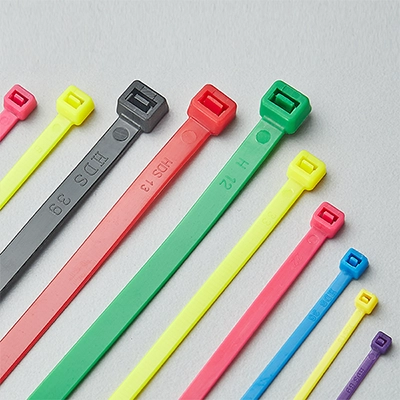
3. Why do retail cable ties come in more colors than industrial ones?
If you look at cable ties on retail shelves, you will often find more color options than in industrial channels. This is not just for visual appeal. In retail, color serves a different purpose.
For everyday home users, color is a practical tool. Different colors can be used to organize different types of cables or mark different areas — power cables in one color, data cables in another. Color also makes a product more visually interesting on the shelf, which can support buying decisions. Because retail buyers are often looking for something convenient and easy to use, a colorful mixed pack or a range of color options adds perceived value without adding complexity.
Industrial cable ties, by contrast, tend to focus more on performance than appearance. Black and white are the most common colors in industrial channels — not because variety is unavailable, but because color is less of a selling point when buyers are focused on tensile strength, material grade, and application fit. For industrial buyers purchasing in bulk, color variety adds inventory complexity without adding much practical value.
In short, color tends to play a more visible role in retail cable ties, while in industrial cable ties, it is usually secondary to function.
4. What are the common sizes and quantities in retail cable ties?
On retail shelves, cable tie sizes are usually more focused. Common products are often narrower and not too long. Sizes such as 2.5×100 mm, 3.6×200 mm, and 4.8×200 mm are often seen in retail stores.
These sizes work well for everyday use. They are suitable for home cable management, tying small items, organizing loose things, and simple fixing jobs. For retail buyers, these are easy sizes to understand and easy sizes to sell.
The pack quantity is also different from industrial sales. Retail cable ties are usually sold in small or medium packs, such as a few dozen pieces or around 100 pieces per pack. This is more suitable for retail use. A customer can buy one pack, use it right away, and not end up with too many extra pieces.
So on a retail shelf, the goal is usually not to show every possible cable tie size. It is to present the most common sizes that cover the most common daily needs.
5. How Do Retail Cable Ties Differ from Industrial Cable Ties?
At first glance, retail cable ties and industrial cable ties may look similar. Both are still cable ties. But once you look at how they are sold and used, the difference becomes clear.
The main differences can be summarized as follows:
| Dimension | Retail Cable Ties | Industrial Cable Ties |
| Pack size | Small packs, typically 50–200 pcs, hook display | Large packs, 1,000 pcs+, carton or bulk bag |
| Size range | A few common sizes covering general daily use | Wide range, fine-tuned by width, length, material, and performance |
| Key product info | Color, length, quantity — what the consumer needs to decide quickly | Tensile strength, material grade, temperature range, certifications |
| Colors | Wider color range; color used as a feature for organization and shelf appeal | Mainly black and white; color is secondary to performance |
| Typical use | Home use, light organizing, quick fixes, occasional needs | Equipment assembly, wire harness management, and long-term installations |
| Buying process | Quick shelf decision, low effort, sometimes impulse | Specification-based selection, batch ordering, and longer lead time |
| Branding and packaging | Packaging is a sales tool; brand or private label | Functional labeling; brand presence is less important |
| Pricing logic | Consumer perceived value: higher cost per piece | Volume-driven pricing; very low cost per piece |
6. What do retail cable ties tell us about product planning?
Looking at how cable ties are sold in retail stores, a few common patterns can be seen.
Retail products need to be easy to understand
On a retail pack, the most visible information is usually the information that helps buyers make a quick decision: color, size, and quantity. Technical details such as tensile strength, material grade, or flame rating may still appear on the pack, but they are usually not the first things most retail buyers look at. In retail, the goal is often not deep product evaluation, but quick confirmation that the product fits the intended use.
Retail shelves usually focus on fast-moving basics, but color variety can still play a role
Retail cable ties often keep a focused range of common sizes, while color options may be broader than in industrial channels. This is especially true for home-use packs, where mixed colors can make the product more visible on the shelf and more useful for simple cable sorting.
Retail cable ties are usually meant for quick purchase and immediate use
Most retail buyers are not standing in front of the shelf comparing technical data in detail. In many cases, they want a product they can understand quickly, take home, and use the same day. Because of that, packaging style, size selection, and information layout in retail cable ties are often arranged in a simpler and more direct way. This is different from industrial purchasing, where buyers usually spend more time comparing specifications, quantities, and application requirements.
Conclusion
Cable ties sold in retail stores may look like smaller versions of industrial products, but in practice, they follow a different retail logic. Packaging needs to work on the shelf, sizes are usually centered around common daily use, and product information needs to be easy to read at a glance. Color can also play a more visible role in retail, where it helps with shelf appeal and simple everyday organization.
For B2B buyers and product planners, understanding this retail logic is not only about knowing what appears on the shelf. It also helps explain why the same cable tie may need different packaging, size choices, and product presentation depending on the sales channel.
Retail cable ties and industrial cable ties may be made from the same material, but they are built for different problems — and sold accordingly.