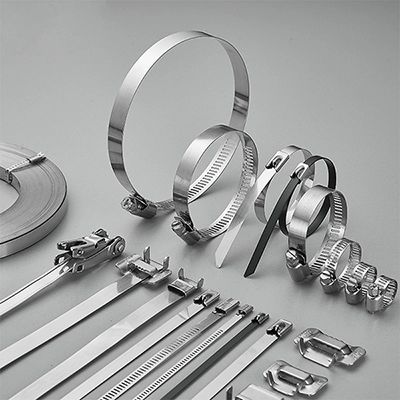
In general, standard nylon cable ties last about 5–10 years indoors and around 1–2 years outdoors. UV-resistant black cable ties usually last 5–7 years outdoors, while stainless steel cable ties can last 20–50+ years depending on the grade and environment.
However, cable tie lifespan is not fixed. It depends mainly on material, UV exposure, temperature, chemical contact, mechanical stress, and installation quality.
If you are using cable ties in outdoor, high-heat, marine, or industrial environments, choosing the right type matters far more than the initial cost.
Cable Tie Lifespan at a Glance
| Cable Tie Type | Indoor Lifespan | Outdoor Lifespan | Best For |
| Standard PA66 cable ties | 5–10 years | 1–2 years | Indoor wiring, light-duty bundling |
| UV-Resistant cable ties | 5–10 years | 5–7 years | Outdoor, garden, solar panels |
| Heat-resistant cable ties | 5–10 years | 3–5 years | Engine bays, warm equipment areas |
| Stainless Steel cable ties (304) | Decades | 20–30 years | Industrial, outdoor structures |
| Stainless Steel cable ties (316 Marine) | Decades | 30–50+ years | Coastal, marine, chemical environments |
| Coated Stainless Steel | Decades | 20–40 years | Sensitive surfaces, telecom towers |
Note: These are typical service-life estimates for general applications. Actual performance will vary depending on sunlight, temperature cycles, chemicals, vibration, load, and installation method.
5 Factors That Affect How Long a Cable Tie Lasts
1. UV Exposure
For nylon cable ties, UV is one of the biggest causes of outdoor failure.
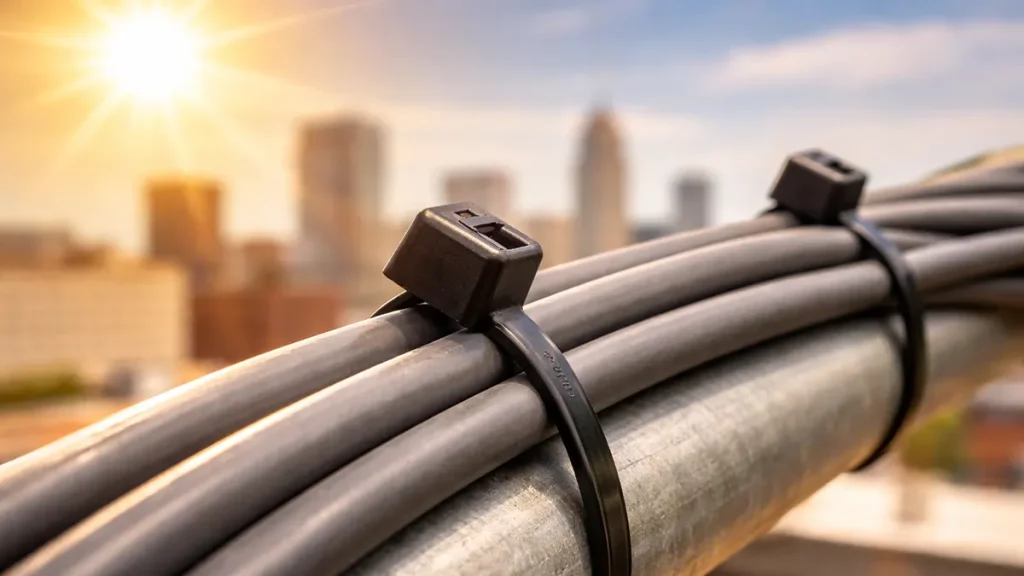
When standard nylon ties are exposed to sunlight for long periods, the polymer gradually breaks down. The tie may become faded, dry-looking, brittle, and more likely to crack under load. In many outdoor installations, a standard natural or white nylon tie can begin to weaken within about a year.
UV-resistant cable ties perform much better because they contain UV-stabilizing additives, which help protect the material from sunlight. That is why UV-stabilized ties are widely used for outdoor cable management, fencing, signage, and solar installations.
One important point: not every black cable tie is UV-resistant. Some are simply black in color. Always check the product specification.
2. Temperature
Temperature also has a major effect on service life.
Standard nylon 66 cable ties are commonly used within a normal working range of around -40°C to +85°C. Outside that range, aging speeds up.
High temperatures can cause the tie to lose strength over time, relax under load, or deform.
Very low temperatures can reduce flexibility and increase the chance of sudden snapping under impact or vibration.
For hotter environments such as engine compartments, industrial machinery, or equipment near heat sources, heat-stabilized nylon cable ties are usually the better choice. For even harsher conditions, stainless steel is often more reliable.
3. Chemical Exposure
Cable ties used around chemicals may fail earlier than expected, even if they look fine at first.
Nylon has good resistance to many common substances, but not all. Certain acids, solvents, oils, fuels, or aggressive cleaning chemicals can attack the material and shorten its life. In these environments, it is not enough to choose by tensile strength alone. Chemical compatibility matters.
If the application involves regular contact with chemicals, salt spray, oil mist, or fuel, stainless steel cable ties are usually the safer long-term option.
4. Mechanical Load & Installation Tension
Mechanical load is another key factor in cable tie lifespan. Over-tightening creates constant stress on the locking head, which can accelerate fatigue and cracking over time. Overloading is also a common problem. If a cable tie is used beyond its rated tensile strength, or if the tie is simply too small for the actual load, it may stretch, loosen, or break early. For long-term use, the tie should be correctly sized for the application and tightened firmly, not excessively.
As a simple reference, cable tie tensile strength generally increases with tie width:
| Cable Tie Width | Typical Minimum Loop Tensile Strength |
| 2.5 mm | 8 kg |
| 3.6 mm | 18 kg |
| 4.8 mm | 22 kg |
| 7.6 mm | 55 kg |
| 9.0 mm | 80 kg |
| 12.0 mm | 114 kg |
Note: Actual tensile strength varies by material, design, and manufacturer. Always check the product datasheet for the exact specification.
5. Storage Conditions Before Use
Cable ties can also age in storage before they are ever used. Nylon is hygroscopic, which means it absorbs moisture from the air. Poor storage conditions such as direct sunlight, high heat, damaged packaging, or very dry environments can affect flexibility and performance before the tie is even used.
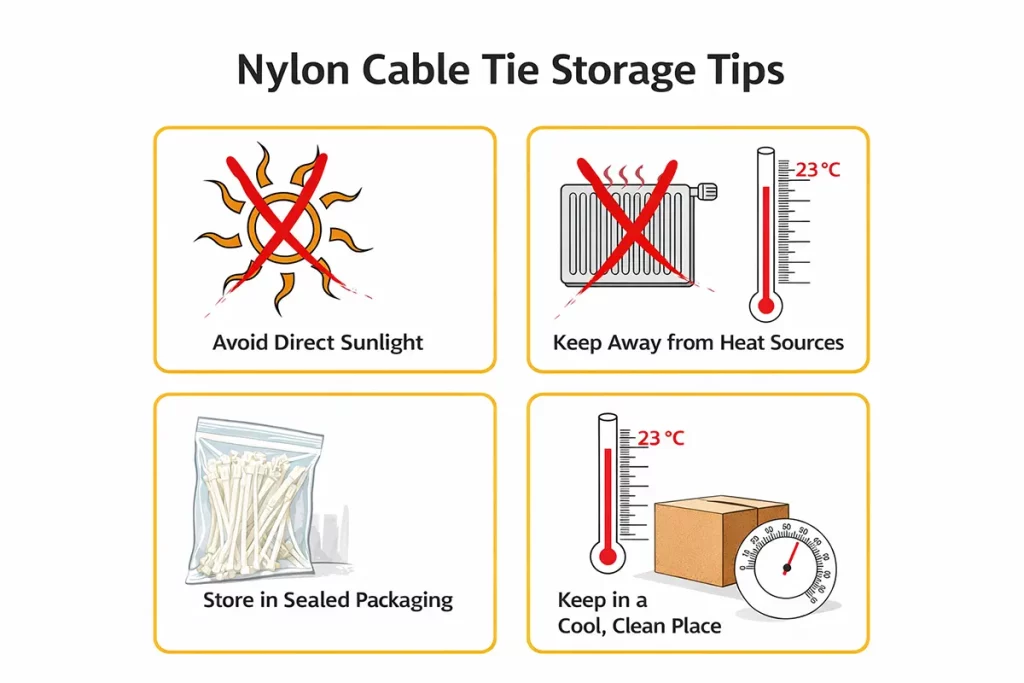
For best results, unused cable ties should be kept in sealed packaging, away from direct sunlight, in a cool and clean storage area, and away from heat sources.
Properly stored nylon cable ties can remain usable for many years, but older stock should still be checked before being used in critical applications.
Material Differences That Affect Lifespan
Does Nylon 6 vs. Nylon 66 Matter?
Yes. In general, Nylon 66 cable ties usually last longer than Nylon 6 cable ties under the same conditions. That is because PA66 has better heat resistance, higher stiffness, and better creep resistance. In practical terms, it holds its shape better under long-term load, loses tension more slowly, and performs more reliably in higher-temperature applications. By comparison, PA6 is more flexible, but it is more prone to deformation over time when the tie stays under continuous stress.
This is one reason why PA66 is more widely used for cable ties when long-term durability matters. For a more detailed comparison, see our article on Nylon 66 cable tie vs Nylon 6 cable tie. If you want to understand why long-term deformation affects service life, you can also read our article about cable tie creep.
Stainless Steel Cable Ties
Stainless steel ties are in a different category entirely. They don’t degrade from UV, don’t become brittle in cold, and resist most chemicals. The main variants are:
- 304 Stainless Steel — Standard grade. Excellent corrosion resistance for most environments. Suitable for outdoor infrastructure, telecom, and industrial use. Lifespan: 20–30 years outdoors.
- 316 Stainless Steel — Marine grade with added molybdenum for superior resistance to chloride (saltwater) corrosion. Essential for coastal, offshore, and chemical applications. Lifespan: 30–50+ years.
- Coated Stainless Steel — A nylon or polymer coating over a stainless steel band. Protects cable insulation from the sharp metal edge while retaining metal strength. Common in telecom tower installations and automotive wiring.
Lifespan by Application
Solar Panel Installations
Solar panels are designed to last 25 years, but the cable ties securing their wiring often fail much earlier. Continuous UV exposure, daily temperature cycling, and moisture make solar installations one of the harshest environments for nylon cable ties.
Standard nylon ties are usually not suitable here. Even UV-resistant nylon ties may age faster in areas with intense sunlight, high heat, or high humidity. In practice, UV- and heat-stabilized nylon cable ties are often used where periodic replacement is acceptable, while stainless steel cable ties are the better choice for long-term or permanently exposed installations, especially in coastal areas.
Automotive and Engine Bay Use
Under-hood applications combine heat, oil, vibration, and confined spaces. Standard nylon may harden, loosen, or age too quickly in these areas.
For engine bay routing, heat-stabilized nylon cable ties are generally preferred. Near very hot components or in permanent fixing points, stainless steel ties may be the safer choice.
Marine and Coastal Environments
Coastal air, salt spray, and humidity are especially demanding. In these environments, 316 stainless steel cable ties are usually the correct specification.
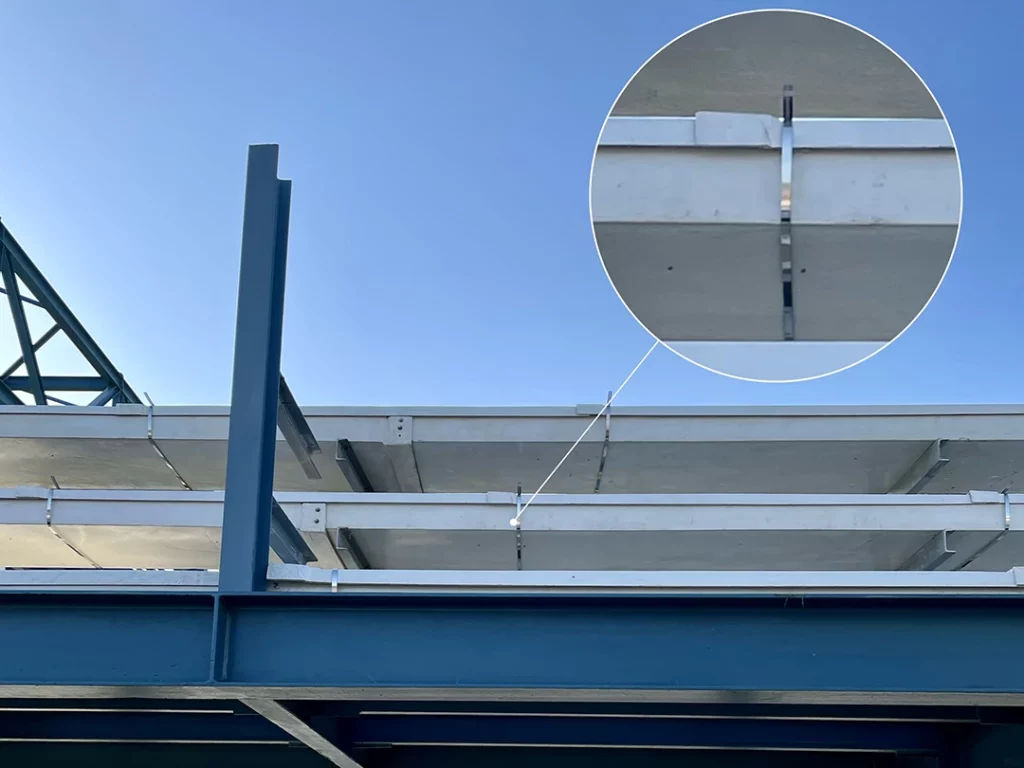
Even UV-resistant nylon may have a shorter effective life if salt, heat, and sunlight are all present over time.
Indoor Electrical & IT Installations
Indoor cable management is usually much less demanding. In server rooms, distribution cabinets, office cable routing, and general indoor bundling, standard nylon 66 cable ties are normally sufficient.
Outdoor Construction & Infrastructure
For fencing, utility poles, signs, outdoor communication lines, or exposed cable runs, UV-resistant nylon should be considered the minimum for nylon ties.
If the installation is intended to remain in service for many years with minimal maintenance, stainless steel is usually the more reliable option.
How to Tell When a Cable Tie Needs Replacing
Do not wait until a cable tie fails in service. Regular inspection can help you spot early signs of aging before the tie breaks or loses its holding performance. Look for the following warning signs:
- Discoloration: Yellowing, whitening, or a dull surface may indicate UV aging and material degradation.
- Brittleness: If the tie cracks or snaps easily when flexed, it has likely become too brittle for continued use.
- Looseness: A tie that no longer holds the bundle firmly may have stretched, crept, or deformed over time.
- Visible cracks: Small cracks at the head or along the strap are a clear sign that the tie is nearing failure.
- Surface chalking: A powdery or chalky surface often means the outer layer is degrading from long-term exposure.
Best Practices to Maximize Cable Tie Lifespan
- Match the material to the environment — do not use standard nylon outdoors.
- Tighten to firm tension, not maximum tension — avoid excessive stress on the locking head.
- Store unused ties in sealed bags away from heat, moisture, and UV light.
- Set a periodic inspection schedule for safety-critical installations, especially for outdoor use.
- For outdoor installations, plan a replacement interval rather than waiting for visible failure.
Frequently Asked Questions
Q: How long do cable ties last outdoors?
Standard nylon cable ties typically last about 1–2 years outdoors. UV-resistant cable ties usually last longer, while stainless steel cable ties are the best choice for long-term outdoor use, especially in harsh environments.
Q: Do cable ties have a shelf life?
Yes. Cable ties can age during storage. Under normal storage and use conditions, we generally provide a one-year warranty to our customers. To help maintain performance, cable ties should be stored in a cool, dry place away from direct sunlight and heat sources. Before using older stock in important applications, it is best to check whether the ties are still flexible and in good condition.
Q: Are black cable ties more UV-resistant than white ones?
Not necessarily. As we mentioned in article “Are UV-Resistant Cable Ties Only Available in Black?” Color alone does not determine UV resistance. What matters is whether UV-resistant additives have been added to the material. Some black cable ties are UV-resistant, while others are only black in color. So black ties are not automatically more UV-resistant than white ones.
Q: Can cable ties be reused?
Standard self-locking cable ties are generally designed for single use. Releasing and reusing them may damage the locking pawl and reduce holding strength. If reusability is required, reusable cable ties are a better option.
Q: How do I know if a cable tie is UV-resistant?
The most reliable way is to check with a professional cable tie manufacturer. A qualified manufacturer should be able to confirm whether the material contains UV-resistant additives and whether the product is suitable for outdoor use.
Q: What is the longest-lasting cable tie available?
For long-term use in harsh environments, 316 stainless steel cable ties are generally the most durable option. They are widely used in marine, coastal, and chemical environments where high corrosion resistance is needed.
Conclusion: Match the Tie to the Job
Cable tie lifespan depends on using the right material in the right environment. In many cases, the cheapest tie is not the most economical choice in the long run. When reliability matters, choosing a better-specified cable tie and replacing it before failure usually costs far less than dealing with damage, downtime, or rework.
If you are not sure which cable tie is suitable for your application, we can help. With 25 years of manufacturing experience in nylon cable ties, we understand how different environments affect performance and can help you choose a more suitable option for your actual working conditions.