When buyers look for fluoropolymer cable ties, they often run into a confusing detail: one supplier lists a working temperature around 150–170°C, while another claims up to ~260°C. Which one is correct?
In most cases, both can be correct—because they are not the same material. “Fluoropolymer cable ties” is a broad category, and the two most common options are ETFE cable ties (often referred to as Tefzel™ ETFE) and PFA cable ties (often sold as Teflon™ PFA). They share excellent chemical resistance, but they belong to different continuous service temperature classes and are chosen for different priorities.
This guide explains the key differences between ETFE vs PFA cable ties, why the market shows two temperature ranges, and how to choose the right tie for your application.
1. What are ETFE and PFA cable ties are
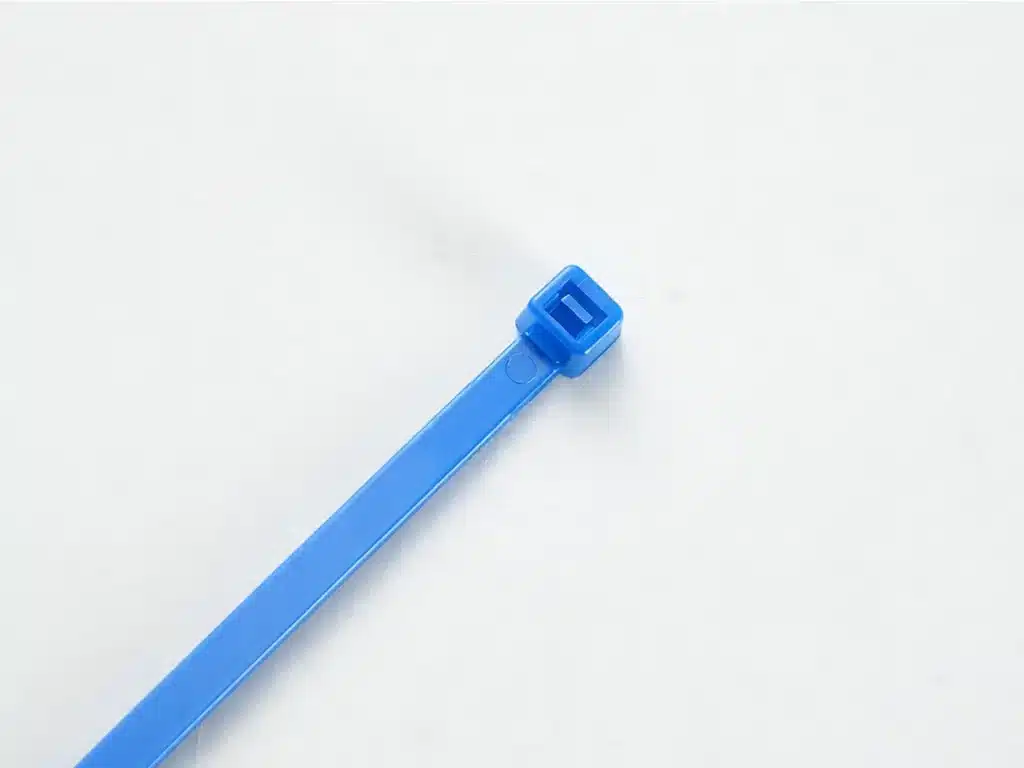
ETFE (often known by the brand name Tefzel™) is a tough fluoropolymer widely used for cable management in demanding industrial environments. ETFE ties are popular because they offer a strong balance of mechanical toughness, chemical resistance, and heat performance.
PFA (often sold as Teflon™ PFA) is a higher-temperature fluoropolymer. PFA ties are chosen when the application pushes closer to extreme continuous heat or when you need maximum thermal stability alongside chemical resistance.
2. Key differences at a glance
ETFE cable ties
- Excellent toughness and abrasion resistance: good for vibration, rubbing, and tight routing
- Strong chemical resistance: suitable for many oils, fuels, solvents, and industrial chemicals
- Typical continuous service temperature class around ~150°C (some suppliers list higher ranges depending on their test method and safety margin)
- Often more common and easier to source in standard sizes
PFA cable ties
- Higher continuous service temperature—commonly in the ~260°C class
- Excellent chemical resistance plus better thermal stability at high heat
- Preferred when heat is the primary failure risk, especially over long durations
- Usually higher cost and sometimes longer lead times, depending on size/color requirements
3. Temperature ratings: what’s actually being confused
Most confusion comes from treating “fluoropolymer cable ties” as one single product with one single temperature limit. In practice, different fluoropolymers have different continuous service temperature classes:
ETFE cable ties are typically used in the ~150℃ class for long-term service (some suppliers may list 150–170℃ depending on their product spec and test method).
PFA cable ties are commonly rated for long-term service in the ~260℃ class, which is why many people associate fluoropolymer ties with 260℃.
So when you see both “170℃” and “260℃” in the market, it is usually not a contradiction—it is often simply ETFE vs PFA being discussed under the same fluoropolymer cable tie name.
| Item | ETFE Cable Ties (Tefzel™ ETFE) | PFA Cable Ties (Teflon™ PFA) |
| Working temperature | ~150°C class | ~260°C class |
| Mechanical toughness | Excellent (abrasion/vibration) | Good (selected for heat stability) |
| Chemical resistance | Excellent for many industrial chemicals | Excellent for many industrial chemicals |
| Typical use cases | Often higher cost, and may have fewer standard stock options | ovens/heaters, high-temp zones with long exposure, heat + chemical combined, critical applications where downtime is costly |
| Cost & availability | Usually more common and easier to source in standard sizes | Often higher cost and may have fewer standard stock options |
4. When Does It Make Sense to Use Fluoropolymer Cable Ties?
Fluoropolymer cable ties stand out for three reasons: heat resistance, chemical resistance, and weatherability. They also cost more, so they are best used where standard PA66 nylon ties are likely to fail and where rework is expensive or difficult. Below are the most common situations where fluoropolymer ties are worth it.
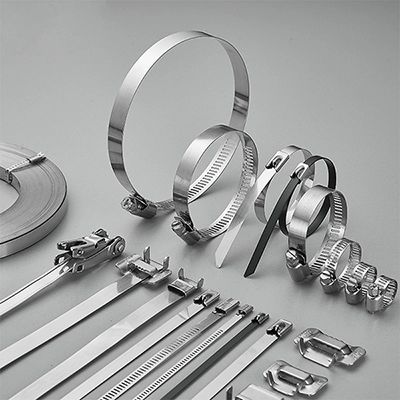
The first typical scenario is continuous elevated temperature. Think of cable bundling near heat sources—around ovens, hot-air ducts, heaters, or other equipment that runs hot for long periods. Over time, standard PA66 nylon ties can gradually soften, lose holding force, and allow harnesses to loosen and rub, which may eventually cause failures. ETFE (Tefzel™) ties are generally more stable for long-term service in the 150–170°C class, which is why many “Teflon” ties in the market are aimed at these applications. That said, if the environment is close to 200°C or higher for extended periods, and the tie must carry a continuous load, it is usually better not to push a plastic tie to the limit. In those cases, consider PFA or move directly to stainless steel cable ties to reduce the risk of loosening over time.
The second scenario is harsh chemical exposure—strong acids/alkalis, solvents, and frequent cleaning agents. This is common in chemical plants, pharmaceutical facilities, laboratories, and areas near cleaning lines where cables are exposed to chemical vapors, solvent evaporation, or repeated wiping and disinfection. In these environments, nylon ties often do not fail immediately; instead, they degrade gradually until they become brittle and break unexpectedly. Fluoropolymers typically offer better long-term resistance here, which is why many users choose them to reduce downtime and rework.
The third scenario is outdoor weathering, especially where UV exposure, large temperature swings, wind, and rain accelerate aging. Typical examples include solar installations, outdoor telecom boxes, and exterior CCTV cabling. Outdoors, the common risk is aging and embrittlement over time—maintenance can be costly, particularly in elevated or hard-to-access locations. Fluoropolymer ties tend to deliver more stable weatherability and service life. If the job is short-term or maintenance is frequent, UV-stabilized nylon ties may still be sufficient.
Finally, fluoropolymer ties are often chosen in industries that demand higher reliability and consistency, such as precision equipment, semiconductors, and medical devices. These applications may not always involve extreme temperatures, but they place more emphasis on stable material performance and resistance to cleaning agents. A cable tie is a small component, but failures can be time-consuming to troubleshoot—so users in these fields are more willing to upgrade the material for peace of mind.
5. Conclusion
In short, ETFE and PFA cable ties are both fluoropolymers with excellent chemical resistance, but they serve different priorities. ETFE (Tefzel™) is the practical choice for many industrial jobs because it combines strong toughness with a ~150–170°C long-term temperature class. PFA (Teflon™ PFA) is chosen when continuous heat is the limiting factor, typically in the ~260°C class, especially when heat exposure is long and failure is costly.
To avoid choosing the wrong tie, don’t rely on the general name fluoropolymer cable tie alone. When contacting a cable tie manufacturer, provide three key inputs:
- your maximum continuous (long-term) temperature,
- whether the tie is load-bearing or under constant tension, and
- any chemical/cleaning exposure.
With these details, it becomes straightforward to recommend ETFE, PFA, or stainless steel—and you’ll avoid the common 170°C vs 260°C confusion.