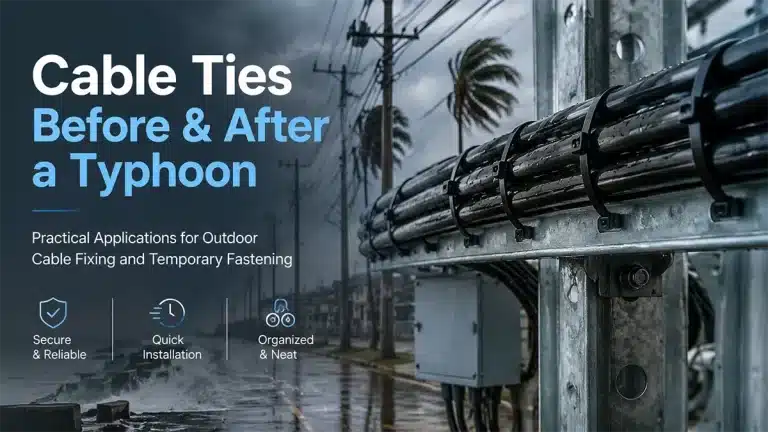
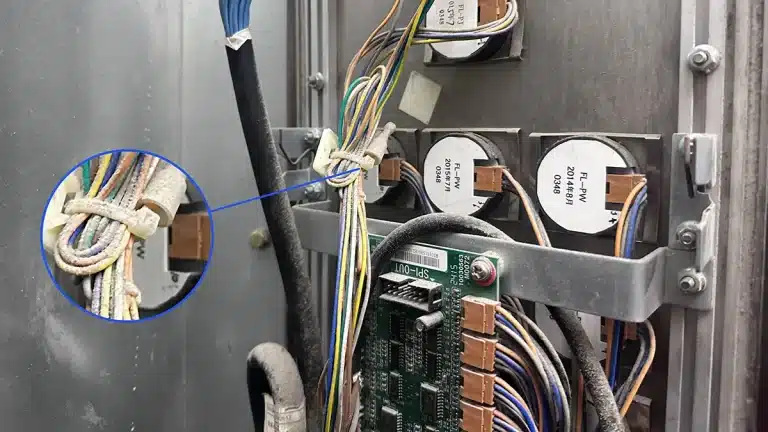
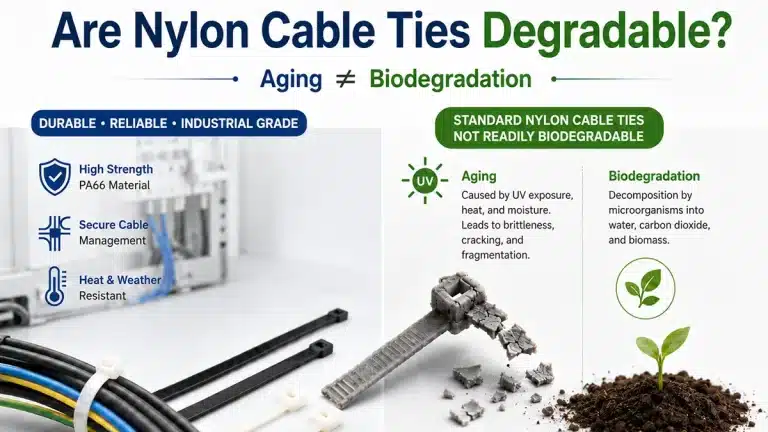
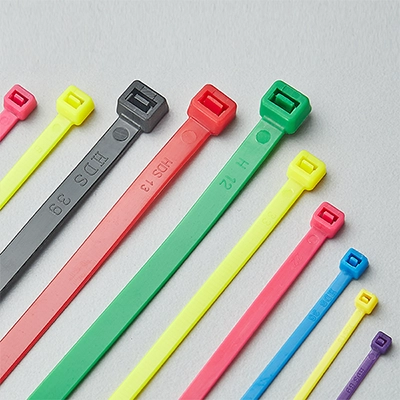
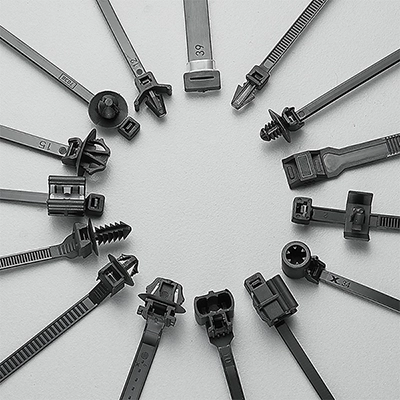
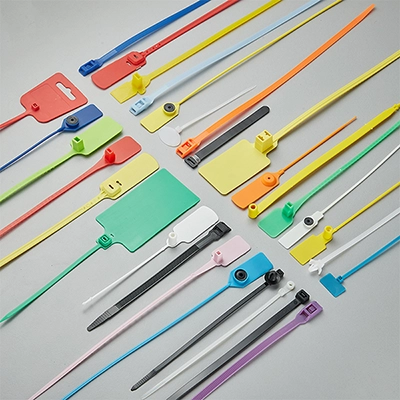
Nylon cable ties are widely used for bundling, fastening, and wire management. In many everyday applications, they are a simple and practical solution. But in real use, there are also situations where other fastening methods are used instead. This may happen when the environment requires higher corrosion resistance, when repeated opening and closing is needed, or when cable ties are simply not available on hand.
That said, cable tie alternatives are not interchangeable. Different tools are designed for different jobs. Some are better for temporary bundling, some are better for routing wires along a surface, and some are made for high-temperature or corrosive environments. In this article, we will look at several common alternatives to nylon cable ties and the situations where each one is most suitable.
1. What Are the Alternatives to Cable Ties?
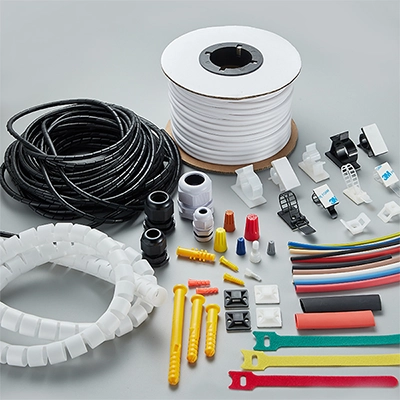
Some of the most common alternatives include hook and loop straps, twist ties, elastic cords, cable clips, cable clamps, rubber bands, and metal fastening products such as stainless steel cable ties or hose clamps. They may all be used to “hold something in place,” but they are not designed for the same purpose.
1.1 Hook and Loop Straps
Hook and loop straps are commonly used for desk cable management, office equipment, and audio-video wiring. They are soft, neat, and suitable for organizing mouse cables, charging cables, monitor wires, and power cords. In places where cables need to be adjusted or rearranged from time to time, they are often a convenient option.
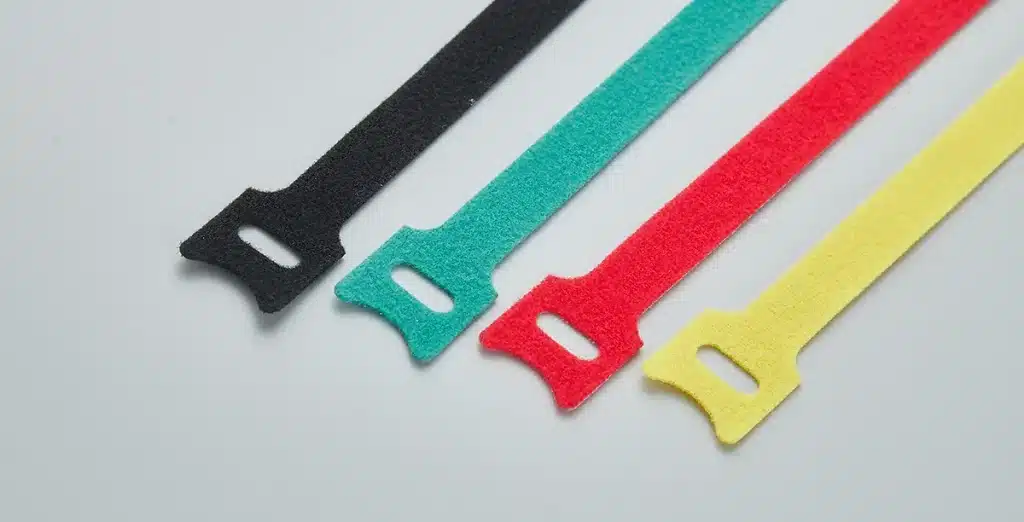
Their main use is light-duty cable organization rather than structural fastening. For equipment installation, outdoor fixing, or heavy-duty bunding, they are usually not the primary choice.
1.2 Twist Ties and Plastic-Coated Wire Ties
Twist ties and plastic-coated wire ties are common light-duty fastening materials. They are often seen in bread bag sealing, fruit packaging, gardening, small item bundling, and temporary organization. Their advantage is simplicity. No extra tools are needed, and they can be twisted quickly by hand.
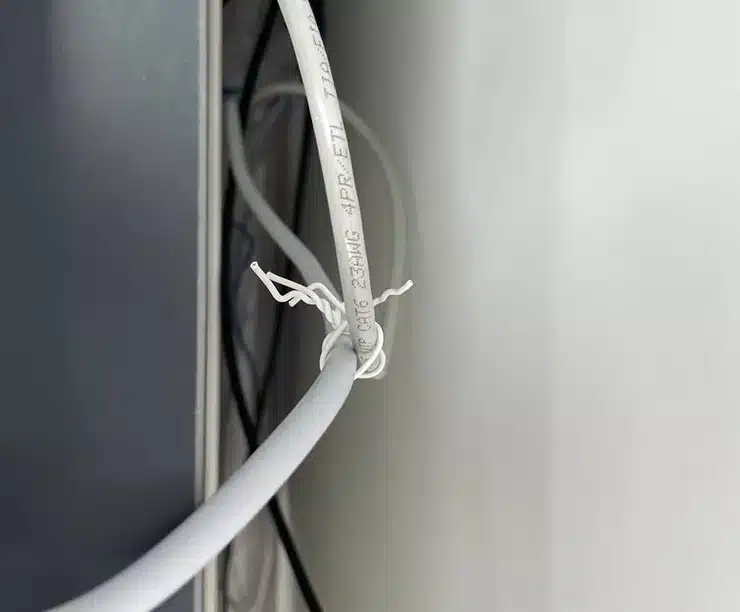
They are best suited to small, lightweight items and short-term use. For example, they work well for sealing bags, tying a few small wires together, or attaching tags. In everyday life, many small appliances and retail packaging applications use this type of fastener.
1.3 Cable Clips, Cable Clamps, and Mounting Bases
If the previous options are mainly for bundling, cable clips, cable clamps, and mounting bases are mainly for positioning. For example, when running a network cable along a wall, routing a charging cable along the edge of a desk, or fixing a wire to a panel, these products are often more suitable than bundling tools.
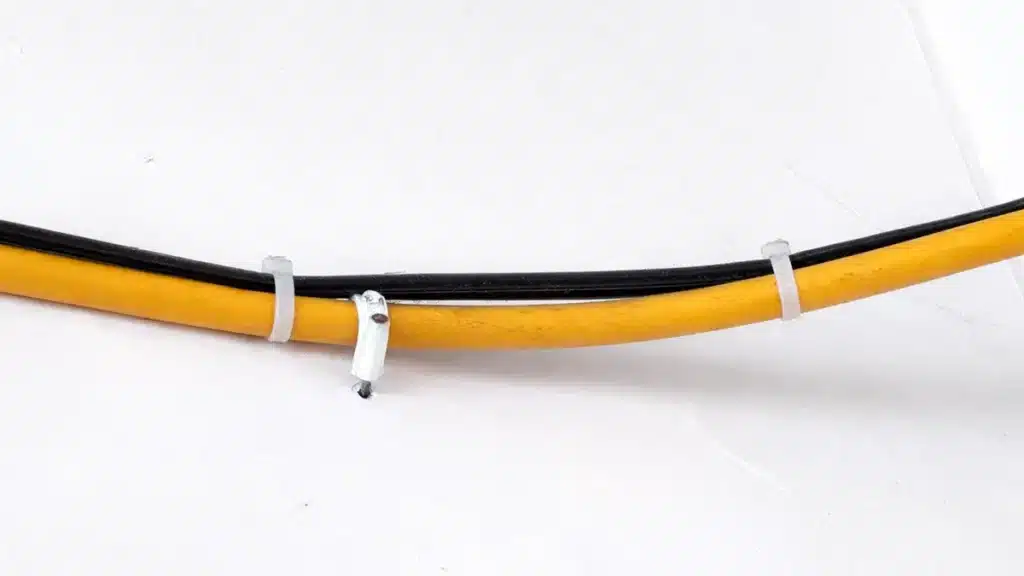
Their purpose is not to gather wires into one bundle, but to keep them routed neatly along a planned path. In-home wiring, office desk cable management, and edge routing inside equipment are often the more appropriate solutions.
1.4 Rubber Bands
Rubber bands are one of the most common temporary fastening tools. When no other material is available, many people use them to hold together charging cables, small bags, pens, or other lightweight loose items. Their biggest advantage is convenience. They are easy to find and quick to use.
However, they are mainly suitable for light-duty, short-term, everyday use. They are practical for quick temporary organization, but they are usually not used for formal installation or long-term fastening.
1.5 Tape
Tape is also a very common temporary solution on-site. When there are no cable ties, no cable clips, and something needs to be secured quickly, tape is often the first thing people reach for. A wire may be taped to a corner temporarily, or a small part may be fixed in place just to prevent movement.
It can be useful for quick handling, but in most cases, it should be viewed as a temporary fix rather than a long-term fastening method.
1.6 Elastic Cords
Elastic cords are different from the smaller fastening materials mentioned above. They are more commonly used for the temporary fixing of larger items. In warehousing, car trunks, transport, luggage holding, or temporary storage, elastic cords are often used to hold boxes, tool bags, or folded items in place.
They are not meant for small wire bundles. Instead, they are better suited to larger objects with irregular shapes or cases where some flexibility is needed. In that sense, their application is quite different from nylon cable ties, but they are a common alternative for temporarily securing large items.
1.7 Stainless Steel Cable Ties, Hose Clamps, and Other Metal Fasteners
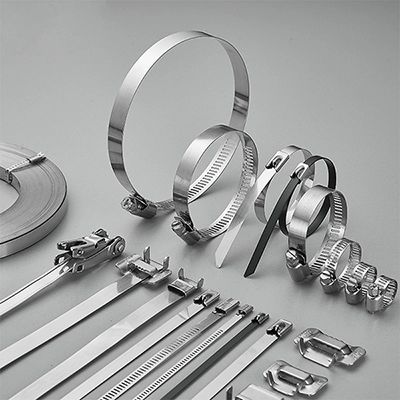
In high-temperature, humid, corrosive, or high-strength applications, people often turn to metal fasteners instead. Common examples include stainless steel cable ties, hose clamps, and steel banding products. These are widely used in piping, equipment, outdoor facilities, ships, chemical plants, and power-related environments.
Compared with standard nylon cable ties, these products are made for more demanding conditions. Strictly speaking, they are not just temporary substitutes, but established solutions for specific working environments.
Before moving on, here is a quick comparison of the main options mentioned above.
| Option | Best For | Reusable | Surface-Friendly | Heavy-Duty Use | Typical Environment |
| Nylon cable ties | General bundling and wire management | Yes | Moderate | Yes | General industrial and daily use |
| Hook and loop straps | Desk cable organization, light bundling | Yes | Yes | No | Office, home, light electronics |
| Twist ties | Bag sealing, small item bundling | Limited | Moderate | No | Retail, household, gardening |
| Cable clips/clamps | Surface cable routing | No/limited | Yes | Moderate | Walls, desks, panels |
| Rubber bands | Temporary light bundling | Limited | Moderate | No | Household, temporary use |
| Tape | Quick temporary fixing | No | Moderate | No | Temporary on-site use |
| Elastic cords | Large-item temporary securing | Yes | Yes | Moderate | Transport, storage, vehicle use |
| Stainless steel cable ties/hose clamps | High heat, corrosion, and high strength | No | Low to moderate | Yes | Outdoor, marine, chemical, and power |
Quick Comparison Table
2. When Are Nylon Cable Ties Still the Better Choice?
Although there are many alternatives, nylon cable ties are still often the better choice in common bundling, fastening, and wire management work. The reason is straightforward. In many applications, people are looking not only at whether something can be secured, but also at installation speed, neatness, size options, and overall cost efficiency.
2.1 When Fast Installation and Batch Work Matter
In factory assembly, wire harness organization, packaging support, and construction work, fastening is often done in large quantities rather than one or two points at a time. In these cases, ease of use and speed matter a lot.
A nylon cable tie can be inserted, tightened, and locked quickly in one simple motion. Tools such as twist ties, tape, or rubber bands may be fine for small temporary tasks, but when the work becomes repetitive and large in volume, the difference in efficiency becomes obvious.
2.2 When a Clean and Uniform Result Is Needed
In many real applications, fastening is not only about keeping things from moving. It is also about keeping the result neat and consistent. Examples include electrical cabinet wiring, internal wire harness organization, and grouped packaging of accessories. In these situations, the finished result should be clear, tidy, and easy to inspect.
Cable ties perform well in this regard because once tightened, they create a clean and uniform fastening result.
2.3 When Flexible Size Selection Is Important
One of the reasons nylon cable ties are used so widely is the wide range of specifications available. Length, width, color, material, and function can all vary. From bundling a few thin wires to helping secure larger bundles or components, there is usually a suitable size available.
Many alternatives can also hold items in place, but they do not always offer the same range of specifications or the same flexibility in application.
2.4 When Practicality, Efficiency, and Cost Need to Be Balanced
In many standard fastening jobs, the goal is not to achieve a special function, but to use a solution that is practical, stable, affordable, and easy to standardize. Nylon cable ties remain widely used because they are balanced in all of these aspects.
For everyday wire management, general bundling, and routine fastening work, they are still one of the most direct and practical options.
Conclusion
There are quite a few tools that can be used instead of nylon cable ties, but most of them are suitable only for certain types of work, such as temporary bundling, surface cable routing, large-item securing, or special environmental conditions. The key is not simply whether a tool can “hold something,” but whether it is the right fit for the actual job.
For most regular bundling, wire management, and installation tasks, nylon cable ties remain one of the most widely used and adaptable solutions. At the same time, understanding these alternatives helps users make better choices when the application calls for something different.