A while ago, our colleague Tom came across a pack of nylon cable ties in a campus store at the University of York and took a few photos for us.
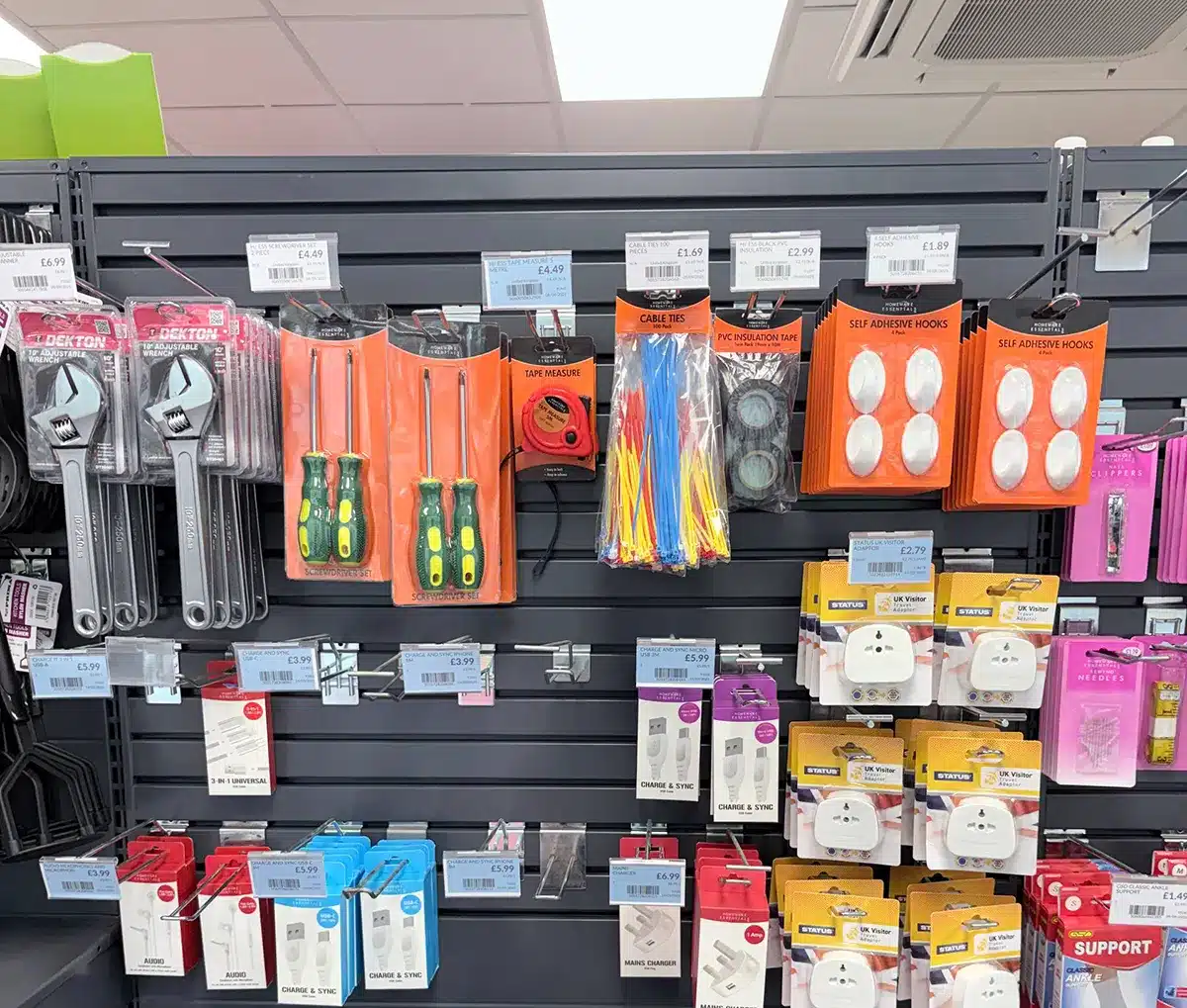
The pack was hanging alongside tape measures, electrical tape, chargers and other everyday tools. It contained around 100 cable ties and was priced at £1.69. For comparison, the electrical tape next to it was £2.99, a tape measure was £4.49, and a charger was £6.99. Among the products on that section of the shelf, the cable ties were one of the lower-priced items.
Most shoppers would probably walk past without giving them much thought. But from a cable tie manufacturer’s point of view, the pack is quite interesting. Most of the orders we handle start with questions about size, material, tensile strength, colour and operating conditions. On a retail shelf, however, the customer is looking at a mixed pack of different colours and sizes. It is still the same basic product, but the way it is selected, packaged and sold is very different.
What Stands Out on a Retail Cable Tie Pack?
The front of the pack is very simple.
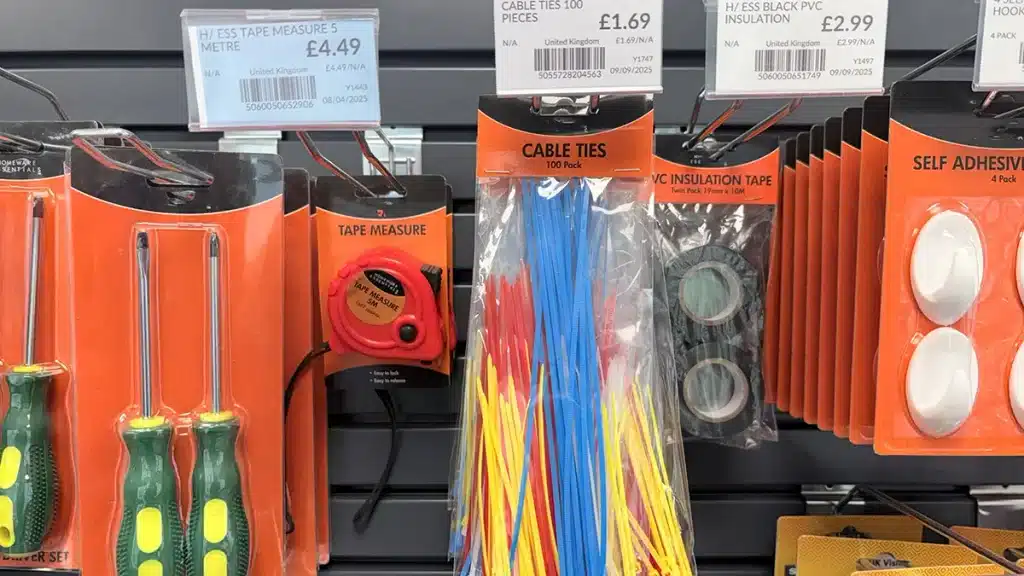
“CABLE TIES” and “100 Pack” are the most prominent pieces of information. Because the bag is transparent, shoppers can immediately see blue, yellow, red and white cable ties inside, as well as several different lengths. There is no need to read a detailed specification sheet to understand what the product is.
The packaging also includes a barcode, REF number, brand information and country-of-origin details. These are all practical pieces of retail information: what the product is, how it is identified in the retail system, where it comes from and who is responsible for putting it on the market.
What is equally interesting is what is not highlighted. From the packaging information visible in the photos, there is no obvious mention of PA66, tensile strength, flame-retardant rating or operating temperature. Exact widths and lengths are not presented as the main selling points either.
That makes sense for the way most consumers buy cable ties in this kind of store. Someone picking up a pack for home use is unlikely to start by comparing minimum tensile strength or checking whether a tie is 2.5 mm or 3.6 mm wide. The more immediate question is whether the pack contains a length and colour that will work for the job at hand.
Industrial buyers purchase a clearly defined component. Retail customers are usually buying a small pack of useful ties that can solve several everyday problems.
What “Approx.” and “Assorted” Tell Us
Two words on the packaging are particularly revealing: “approx.” and “assorted.”
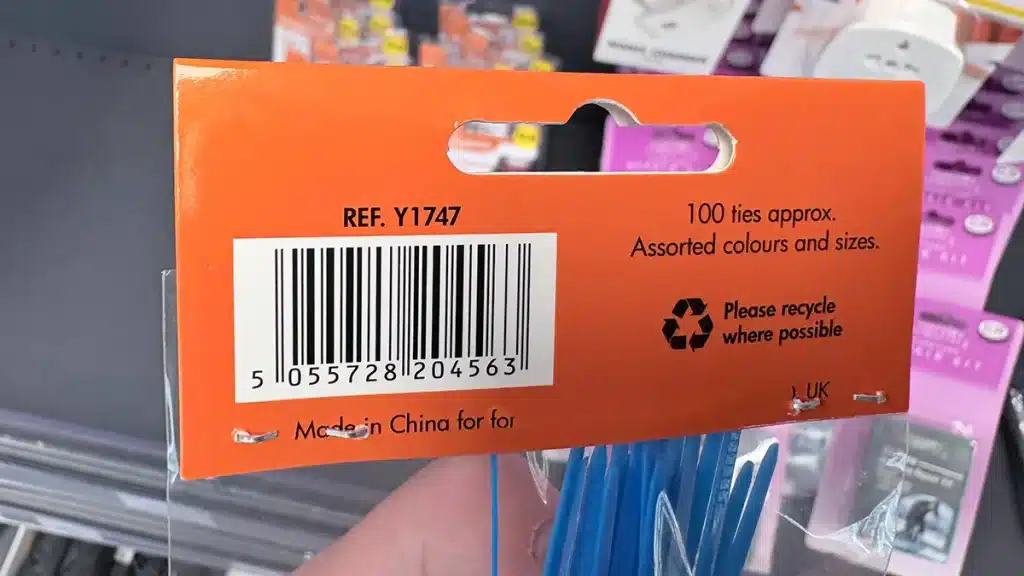
For industrial orders, if a customer specifies 100 pieces per bag, the pack quantity is usually treated as a clear delivery requirement. The number of pieces per bag and bags per carton may tie directly into the customer’s receiving and inventory system.
This retail pack, by contrast, says “100 ties approx.” The wording itself suggests that the quantity is treated more as a nominal retail pack size than as a tightly controlled industrial packing specification.
The word “assorted” is even more telling. The photos show that the ties vary not only in colour but also in length. The blue ties are visibly longer, while the red, yellow and white ties include shorter sizes.
For occasional home use, this can be more practical than buying 100 identical ties. Most consumers do not know in advance whether they will need a 100 mm, 150 mm or 200 mm cable tie next time. A mixed pack gives them several options in one purchase.
There is also a practical benefit for the retailer. Shelf space is limited. If every length and every colour were sold as a separate item, cable ties alone could take up a large number of hooks. An assorted pack allows one SKU to cover several common uses.
In that setting, “Assorted colours and sizes” may tell the shopper more than a list of individual millimetre dimensions.
Retail and Industrial Buyers Look for Different Things
Retail and industrial customers use cable ties in different ways, so naturally they focus on different information.
A consumer may buy a pack to organise computer cables, secure a charging lead, fasten a loose item or handle a quick household repair. What matters most is whether the ties are useful, whether there is a suitable length in the pack, whether there are enough of them and whether the price feels reasonable.
Industrial purchasing works differently. If a cable tie is going into an electrical cabinet, automotive wiring harness, solar installation or another piece of equipment, it becomes a specified component. The customer may define the dimensions, colour, material, minimum tensile strength, flame-retardant rating, operating temperature and packing quantity. Traceability and test reports may also be required.
In other words, an industrial buyer is usually ordering one specific cable tie that must meet a defined set of requirements. A retail customer may prefer a mixed pack that covers several possible uses.
That difference has a direct effect on how the product is presented.
In Retail, Packaging Is Part of the Product
The pack in the photos uses a very typical retail format: a transparent plastic bag, a printed header card and a hang hole for pegboard display.
It is a simple format, but it works well for a low-priced product such as cable ties. The transparent bag lets shoppers see the colours, lengths and approximate quantity inside. The header card carries the product name, barcode, reference number and other commercial information, while the hang hole allows the pack to go straight onto a retail display.
For a manufacturer supplying this type of order, the work does not stop with producing the cable ties themselves. The buyer may also need to define which sizes go into each pack, the colour mix, quantity per pack, bag dimensions, header card design, hang-hole position, barcode and private-label information.
These may look like packaging details, but they can determine whether the product fits smoothly into the customer’s retail system.
The pack in the photo sells for £1.69 per 100 ties, which works out at less than 2 pence per tie. That retail price, however, cannot be used to work backwards to a factory price. Packaging, freight, importing, warehousing, distribution and store operating costs all sit between the factory and the shelf. Mixed-colour and mixed-size packs also require more sorting and packing work than a standard single-size pack.
So for a manufacturer, the £1.69 price tag is only one part of the picture. The packaging format and product mix are often more useful to study.
The Same Cable Tie Becomes a Different Product in a Different Channel
Looking again at the pack Tom photographed, there is nothing especially complicated about it: several colours, several lengths, a transparent bag and a simple header card.
But the format is clearly designed for the way retail customers buy.
Industrial enquiries usually begin with a specific size and performance requirement. Retail projects also need decisions about colour assortment, size mix, header cards, barcodes and shelf presentation.
When we work on retail packaging projects, we therefore confirm not only the cable tie specifications, but also the mix of sizes and colours, quantity per pack, bag or header-card design, barcode requirements and other packaging details.
By the time the product reaches the customer, it is no longer simply a bag of cable ties. It is a finished retail item designed to go directly onto the shelf.