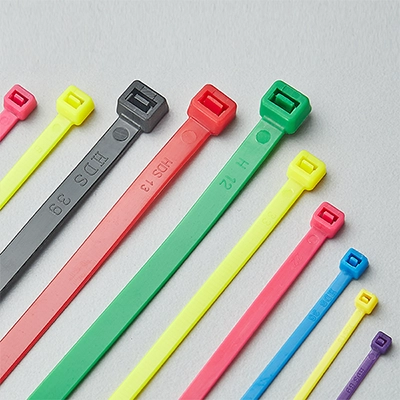
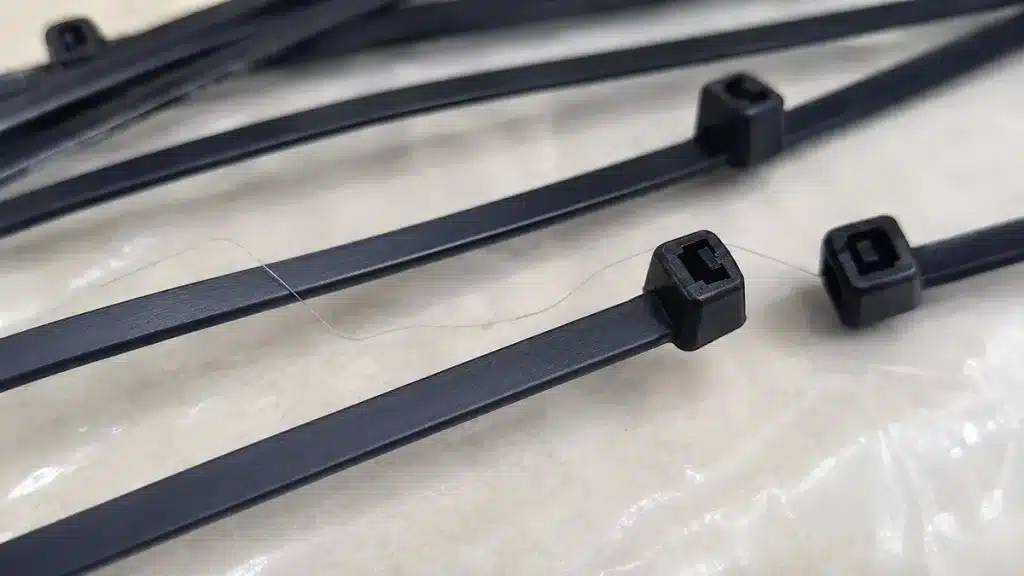
When opening a bag of nylon cable ties, you may occasionally notice a very fine strand caught between the ties. On black cable ties, it can look surprisingly similar to a human hair. On natural or white ties, it may look more like a fiber or lint.
It is reasonable to wonder whether something foreign entered the package during production.
In some cases, however, the strand may not be hair or external contamination at all. If it is extremely fine, elongated, and similar in color to the cable tie material, it may be a small strand of nylon created during the injection molding process. This phenomenon is commonly known as stringing.
That does not mean every strand found in a bag of cable ties should automatically be identified as nylon. Its appearance, location, quantity, and the production conditions still need to be considered before drawing a conclusion.
What Is Injection Molding Stringing?
Most nylon cable ties are manufactured by injection molding.
Nylon resin is dried, heated inside the molding machine until it becomes molten, and then injected into a mold. After cooling and solidification, the molded cable ties are released from the tooling.
Stringing can occur while molten resin is separating from parts of the molding system.
If a small amount of nylon is still hot and viscous when two surfaces separate, the material may stretch instead of breaking immediately. As the distance increases, the resin strand becomes thinner and thinner until it finally breaks and cools.
A simple comparison is melted sugar being pulled apart. The material starts relatively thick, stretches into a much finer thread, and then retains that thread-like shape after cooling.
In injection molding, this is referred to as stringing. Technical literature also documents that polyamide materials can be susceptible to this behavior. U.S. Patent US5516275A, for example, describes resin stringing during injection molding and specifically identifies polyamide among materials prone to the phenomenon. The patent also reports testing with PA66.
How Does a Nylon Strand End Up Inside a Bag of Cable Ties?
A strand may originally form around the nozzle, sprue, runner, or another part of the molding process, but it does not necessarily stay there.
Because these strands can be extremely thin and lightweight, they may detach during:
- demolding;
- product transfer;
- sorting;
- handling;
- or packaging.
A loose strand can then settle on a cable tie or become caught between several ties.
By the time the customer opens the package, it may appear as a single hair-like strand lying across the strap, hanging from one end, or caught between several cable ties.
This is one reason a molding strand can easily be mistaken for hair or another environmental fiber.
Stringing, Flash, and Burrs Are Different Defects
These terms are sometimes used interchangeably when inspecting cable ties, but they describe different things.
| Appearance | What it usually looks like | Typical origin |
| Injection molding stringing | Very thin and long, similar to hair or spider silk | Molten resin is stretched during separation |
| Flash | Thin film or excess material extending along an edge | Resin enters a gap around the mold parting line or another clearance |
| Burr | Short, rough, sharp, or irregular projection | Often associated with gates, trimming, or molded edges |
| Foreign hair or fiber | Color, thickness, shape, or texture may differ from the molded material | May come from the manufacturing, handling, packaging, or surrounding environment |
Flash, for example, generally appears as excess material along the edge of an injection-molded part rather than as a long free strand. BASF also treats flash as a distinct injection molding defect in its technical troubleshooting resources.
So if someone reports that there is “hair” on cable ties, it should not immediately be classified as a burr, flash, or molding string. The first step is to determine what is actually present.
Can You Tell Whether It Is Nylon Just by Looking at It?
Not with certainty.
Injection molding stringing does occur, but real hair, lint, packaging fibers, and other foreign material can also enter a package.
It would therefore be incorrect for a cable tie manufacturer to explain every hair-like object as “just nylon stringing.”
Some characteristics may make molding stringing more likely. For example, the strand may:
- closely match the color of the cable tie;
- be extremely fine and relatively uniform;
- have a stretched or drawn appearance;
- resemble strands found near molded runners or gates.
On the other hand, if a strand has a noticeably different color, thickness, curl, or texture, it deserves further investigation.
The quantity also matters. One isolated strand and a package containing many unidentified fibers are very different situations.
For a manufacturer, this distinction is important: understanding how stringing occurs does not replace foreign-material control.
Why Does Nylon String During Injection Molding?
There is no single cause that explains every case.
Stringing is affected by the condition of the molten resin and the way the molding system operates. Factors that may be relevant include:
- nozzle temperature;
- melt condition;
- nozzle design;
- screw decompression;
- back pressure;
- and the specific mold and runner configuration.
Technical processing guides for nylon also discuss related nozzle-control issues such as drooling. Suggested adjustments can include reducing nozzle or melt temperature, reducing back pressure, increasing screw decompression, or changing nozzle design depending on the actual cause.
It is important to distinguish drooling from stringing: they are not exactly the same defect. However, both involve the behavior of molten resin around the nozzle and can be influenced by some of the same processing conditions.
This is why it is usually too simplistic to say that stringing is caused only by “bad raw material” or simply by “temperature being too high.”
The actual cause should be evaluated against the machine, material, mold, and processing conditions being used.
Does a Fine Nylon Strand Mean the Cable Ties Are Defective?
Not necessarily.
A loose nylon strand attached to or resting on the surface of cable ties does not, by itself, demonstrate that the cable tie has insufficient tensile strength or poor functional performance.
The mechanical performance of cable ties depends on factors such as:
- resin properties;
- strap dimensions;
- tooth geometry;
- locking-head design;
- molding quality;
- and the condition of the finished product.
A small loose strand on the surface does not directly determine these properties.
That does not mean it should simply be ignored.
If one or two strands appear occasionally, the issue is more likely to concern appearance and final inspection. If stringing appears repeatedly throughout a production batch, or is accompanied by other molding problems such as abnormal gates, excessive flash, burrs, or incomplete molding, then cleaning the finished product is not enough. The molding process itself should be reviewed.
In other words:
A hair-like strand does not automatically mean the cable tie has failed, but repeated stringing is still something a manufacturer should control.
How Can Nylon Cable Tie Manufacturers Reduce Stringing?
The first step is to reduce the formation of strings during molding rather than relying only on operators to remove them during packaging.
When stringing becomes frequent, the manufacturer can review the relevant process conditions, including nozzle and melt temperatures, back pressure, decompression settings, nozzle condition, and mold or runner configuration.
A useful clue is whether the problem is concentrated around:
- one molding machine;
- one mold;
- specific cavities;
- a particular material batch;
- or a particular period of production.
This can help narrow down the source rather than treating every strand as a random occurrence.
Final inspection remains important as well.
Even with a stable molding process, very fine strands may occasionally occur. Visible strands should be removed during inspection and packaging. If the material found on the cable ties does not resemble molding stringing, it should be treated as a possible foreign material and investigated accordingly.
The two controls serve different purposes:
Process control addresses why the strand is being created. Final inspection addresses why it might reach the customer.
Hair-Like Does Not Always Mean Hair
A thin strand found on nylon cable ties may come from injection molding stringing. Molten nylon can stretch into an extremely fine filament during separation and remain as a hair-like strand after cooling.
But the opposite is also true: not every strand found in a package should be explained as nylon stringing.
For the customer, the first question is what the strand actually is. For the manufacturer, the more important question is whether it came from the molding process, the production environment, or the packaging stage—and whether the occurrence is isolated or repeated.
Understanding that difference helps avoid two mistakes: treating a molding strand as serious foreign contamination, or using “nylon stringing” as an explanation for material that should actually be investigated.