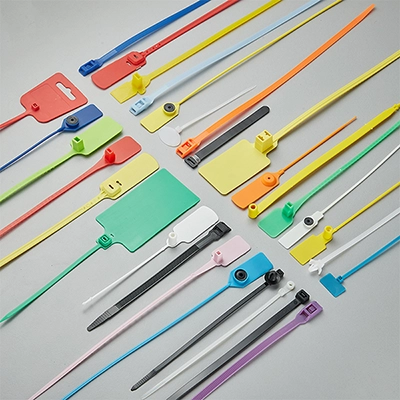
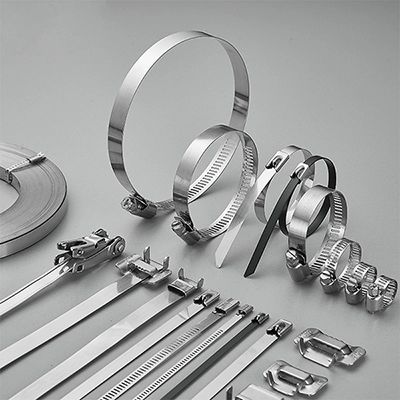
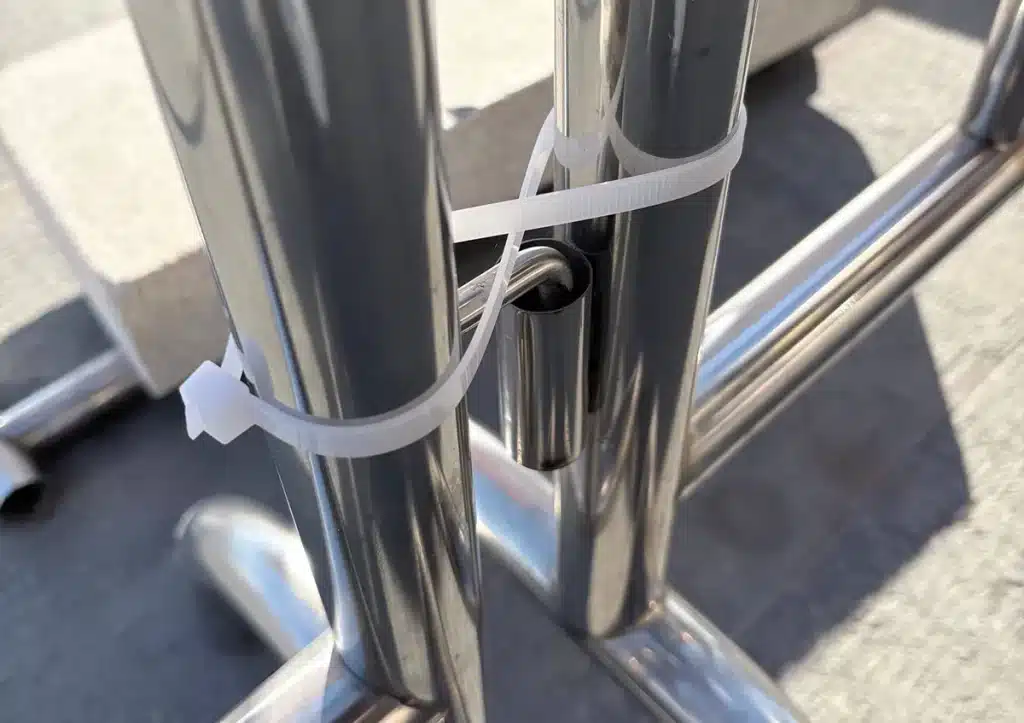
Cable ties are easy to miss at the entrance of Zhongshuge in Zibo—often called China’s “most beautiful bookstore”—but they solve a very practical problem. We noticed a single white cable tie linking two stainless-steel crowd-control barriers, keeping them aligned as foot traffic builds up. When crowds push through, barriers can shift, gaps can open, and sections may even get moved aside. That small cable tie helps “lock” the barriers in place, making the queue route more stable and the entrance flow smoother.
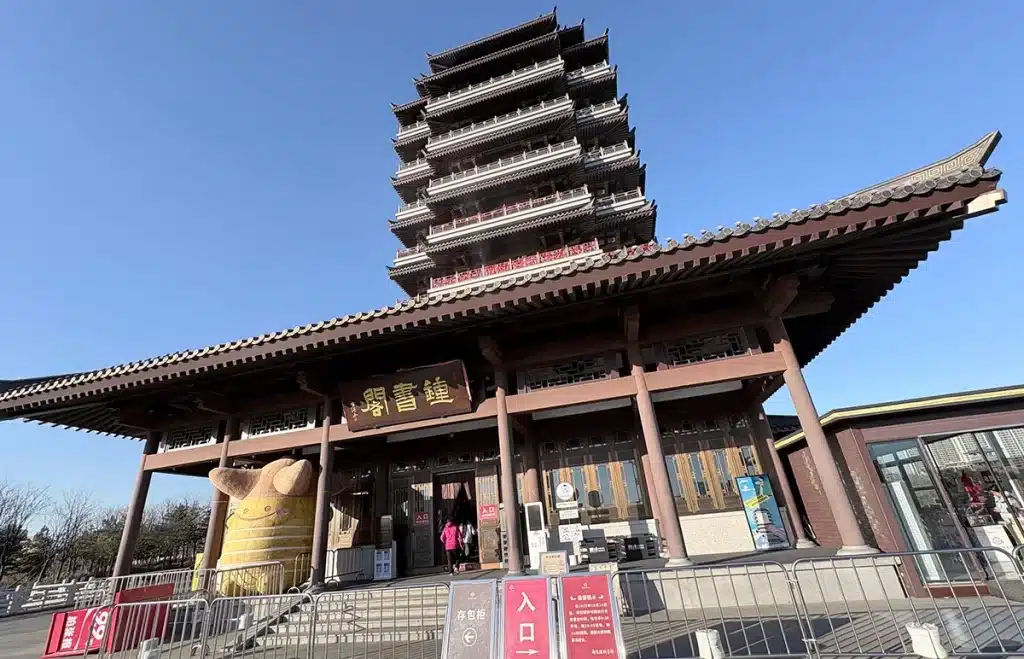
Using this real on-site example, let’s look at how cable ties are actually used in public spaces.
What Do These White Cable Ties Really Do Here?
Up close, the white cable tie loops around the posts of two separate barriers and tightens in the middle, turning two independent sections into one unit. Its job is straightforward: position limiting.
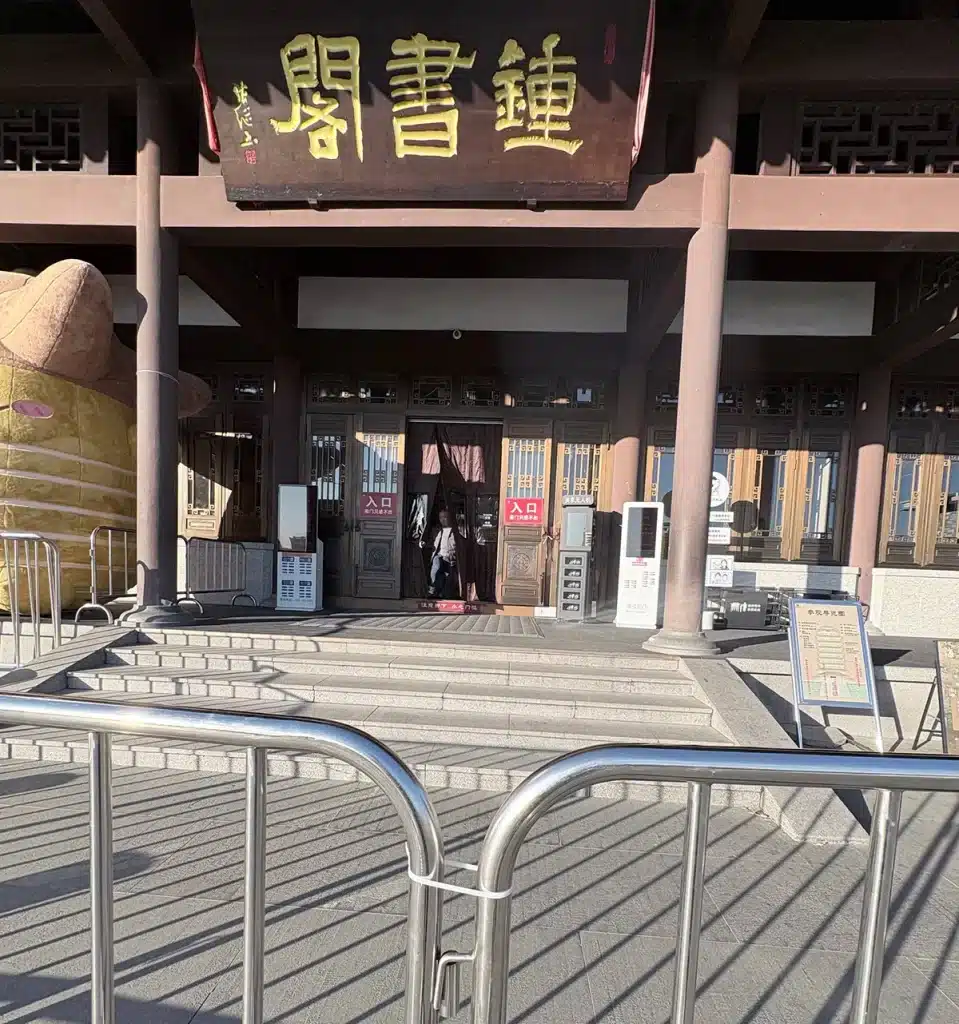
Without this fixing point, the barriers are only loosely overlapped. A bump from passing pedestrians or pressure from a crowded queue can easily shift the posts, and the walking lane quickly becomes crooked or develops gaps. Once the cable tie is tightened, relative movement between the two barriers is restricted. The spacing between posts stays stable, and the “easy-to-open” gaps are effectively closed.
The result is simple but important: people naturally follow the intended route, the entrance line moves more smoothly, and the risk caused by disorder or sudden openings is reduced. For queue control and event guidance—scenarios that need frequent adjustment—this small “linking” action is surprisingly effective.
Why Cable Ties: Fast, Flexible, Easy to Adjust
Why not weld the barriers together, or use steel wire?
Because the needs at an entrance change all the time. Today, the crowd is big, and you add another section. Tomorrow it’s quiet, and you adjust the route. The next day, the whole setup might be removed for an event. In these situations, the advantages of cable ties are obvious.
A self-locking cable tie can be installed in seconds. No drilling, no wrenches, often no tools at all—loop it, pull tight, cut the tail, done. Welding requires equipment and setup. Steel wire takes time to twist and can easily leave sharp ends that scratch passers-by.
Cable ties are also “gentle” on stainless-steel barriers: no holes, no structural damage. If the position isn’t right, you cut it and re-tie—cost is minimal. For a high-traffic entrance that needs constant micro-adjustments, “fast, flexible, easy to reset” is exactly what works.
Small Cable Ties, But There’s Still Some Know-How
If you look carefully, you can actually read some “selection logic” from this simple tie. At a semi-outdoor entrance with heavy traffic, which cable tie is more reliable?
1) Width matters
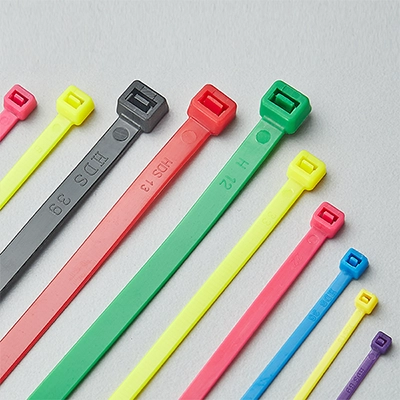
The tie in the photo appears to be at least 4.8 mm wide. It’s not oversized, but once tightened, it’s enough to hold the two barrier sections firmly together. For heavier barriers or stronger load points, people often go to 7.6 mm or wider. For light-duty tasks—temporary signs or cable bundling—4.8 mm is usually sufficient. Different force conditions call for different sizes.
2) Material and UV exposure
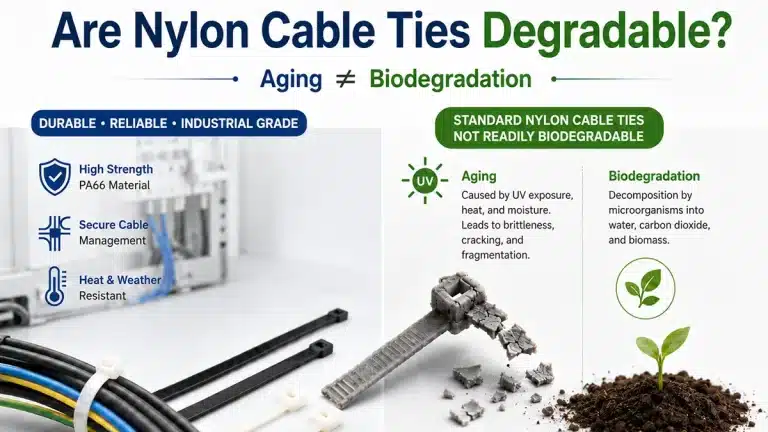
Standard nylon cable ties work fine for short-term use. But outdoors, sunlight is the natural enemy—long UV exposure can accelerate aging and brittleness. If this setup needs to stay in place for months, experienced installers may switch to UV-resistant PA66 cable ties for better weather resistance. For purely temporary use, standard nylon ties are often enough.
3) The cut tail is a safety detail
One commonly overlooked point is how the excess tail is handled. Here, the cut is clean and flush—no sharp burr. That matters at a crowded entrance, especially with kids running around. A sticking tail can snag clothes or scratch skin. A more careful approach is to rotate the locking head toward the inside of the post so people are unlikely to touch it.
4) Extra stability when needed
If one tie isn’t stable enough, people often use two cable ties or cross them into an “X” for better anti-sway. And if the tie is too long and you don’t have cutters, wrapping an extra loop is a quick way to shorten the working length.
Another Kind of “Beauty”: Practical Order
Zhongshuge is beautiful because of its books, space, and design. But if you stand at the entrance long enough, you’ll notice another kind of beauty: the comfort of order—and it often depends on small tools like cable ties. They don’t look special. They’re cheap and ordinary. But for high-frequency, adjustable crowd-control setups, they are one of the most practical solutions: fast, flexible, low-impact, and “just tight enough” to keep barriers where they should be.
Next time you pass Zhongshuge—or line up at a mall or exhibition entrance—take a closer look. Those cable ties that seem casually tied are often there for a reason: to keep the lane stable, the queue smooth, and the site safer. Cable ties don’t steal the spotlight, but in busy public guidance scenarios, they truly work.